Pearson+ LogoPearson+ Logo
Ch.9 Solutions
Timberlake - Chemistry: An Introduction to General, Organic, and Biological Chemistry 13th Edition
Timberlake13th EditionChemistry: An Introduction to General, Organic, and Biological ChemistryISBN: 9780134421353Not the one you use?Change textbook
Chapter 9, Problem 27a

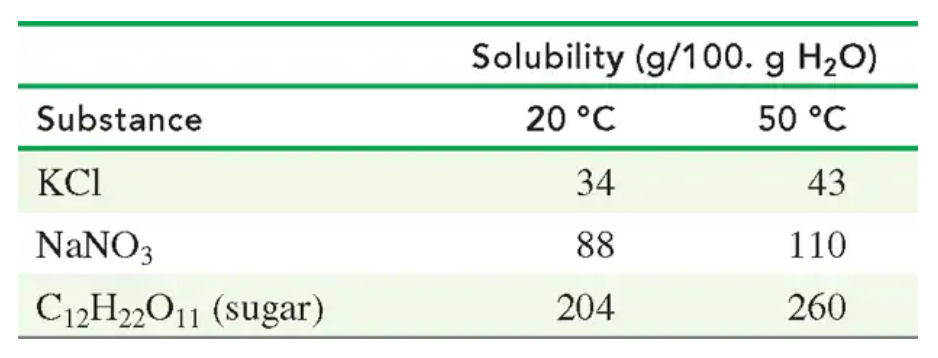
Use the following table:
Table showing solubility of KCl, NaNO3, and sugar in water at 20 °C and 50 °C.
A solution containing 80. g of KCl in 200. g of H2O at 50 °C is cooled to 20 °C.
a. How many grams of KCl remain in solution at 20 °C?

Verified step by step guidance
1
Step 1: Understand the solubility concept. Solubility is the maximum amount of solute (in this case, KCl) that can dissolve in a given amount of solvent (H₂O) at a specific temperature. Any excess solute will remain undissolved as a precipitate.
Step 2: Refer to the solubility table or graph for KCl. Look up the solubility of KCl at 20 °C. This value represents the maximum grams of KCl that can dissolve in 100 g of H₂O at this temperature.
Step 3: Scale the solubility value to match the amount of water in the solution. Since the solution contains 200 g of H₂O, multiply the solubility value (from Step 2) by 2 to determine the maximum grams of KCl that can dissolve in 200 g of H₂O at 20 °C.
Step 4: Compare the initial amount of KCl (80 g) to the maximum solubility at 20 °C (calculated in Step 3). Subtract the maximum solubility from the initial amount to determine how much KCl will precipitate out of the solution.
Step 5: The remaining KCl in solution at 20 °C will be equal to the maximum solubility in 200 g of H₂O at this temperature. This is the amount of KCl that stays dissolved.

Verified video answer for a similar problem:

This video solution was recommended by our tutors as helpful for the problem above.
Video duration:
2m
Was this helpful?

Key Concepts

Here are the essential concepts you must grasp in order to answer the question correctly.

Solubility

Solubility refers to the maximum amount of a solute that can dissolve in a solvent at a given temperature and pressure. In this context, the solubility of KCl in water at different temperatures is crucial for determining how much KCl remains dissolved when the solution is cooled from 50 °C to 20 °C.
Recommended video:
Guided course
00:28
Solubility Rules

Temperature Effects on Solubility

The solubility of most salts, including KCl, typically decreases as the temperature decreases. Understanding how temperature affects solubility is essential for predicting how much KCl will remain in solution after cooling, as the solubility limit at 20 °C will dictate the amount that can stay dissolved.
Recommended video:
Guided course
04:38
Solubility: Temperature Effect Concept 1

Saturation Point

The saturation point is the concentration at which a solution can no longer dissolve additional solute at a specific temperature. When the solution is cooled, it may reach a saturation point where excess KCl precipitates out, making it important to calculate how much KCl exceeds this limit at 20 °C.
Recommended video:
Guided course
03:05
Boiling Point Elevation Concept 1