Pearson+ LogoPearson+ Logo
Ch.9 Solutions
Timberlake - Chemistry: An Introduction to General, Organic, and Biological Chemistry 13th Edition
Timberlake13th EditionChemistry: An Introduction to General, Organic, and Biological ChemistryISBN: 9780134421353Not the one you use?Change textbook
Chapter 9, Problem 29a

Explain the following observations:
a. More sugar dissolves in hot tea than in iced tea.

Verified step by step guidance
1
Understand the concept of solubility: Solubility refers to the maximum amount of a solute (in this case, sugar) that can dissolve in a solvent (tea) at a given temperature. Solubility is influenced by temperature, pressure, and the nature of the solute and solvent.
Recognize the effect of temperature on solubility: For most solid solutes, including sugar, solubility increases as the temperature of the solvent increases. This is because higher temperatures provide more kinetic energy to the solvent molecules, allowing them to interact more effectively with the solute particles and break them apart.
Apply this concept to the given scenario: In hot tea, the higher temperature increases the kinetic energy of the water molecules, which enhances their ability to dissolve more sugar. In contrast, iced tea has a lower temperature, so the water molecules have less kinetic energy, resulting in a lower solubility for sugar.
Relate this to practical observations: When you add sugar to hot tea, it dissolves more readily and in larger amounts because the increased temperature allows the sugar molecules to disperse more easily into the solvent. In iced tea, the lower temperature limits this process, so less sugar can dissolve.
Conclude the explanation: The observation that more sugar dissolves in hot tea than in iced tea is a direct result of the temperature-dependent nature of solubility for solid solutes in liquid solvents.

Verified video answer for a similar problem:

This video solution was recommended by our tutors as helpful for the problem above.
Video duration:
1m
Was this helpful?

Key Concepts

Here are the essential concepts you must grasp in order to answer the question correctly.

Solubility

Solubility refers to the ability of a substance (solute) to dissolve in a solvent, forming a solution. It is influenced by factors such as temperature, pressure, and the nature of the solute and solvent. Generally, higher temperatures increase the solubility of solids in liquids, allowing more sugar to dissolve in hot tea compared to iced tea.
Recommended video:
Guided course
00:28
Solubility Rules

Temperature Effects on Solubility

Temperature plays a crucial role in the solubility of substances. As temperature increases, the kinetic energy of molecules also increases, leading to more frequent and energetic collisions between solute and solvent molecules. This enhanced interaction allows more sugar to dissolve in hot tea than in iced tea, where lower temperatures result in reduced molecular movement.
Recommended video:
Guided course
04:38
Solubility: Temperature Effect Concept 1

Saturation Point

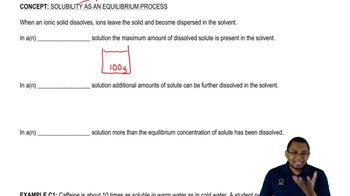
The saturation point is the maximum concentration of solute that can dissolve in a solvent at a given temperature. When a solution reaches this point, no more solute can dissolve, and any additional solute will remain undissolved. In hot tea, the saturation point for sugar is higher than in iced tea, enabling more sugar to dissolve before reaching saturation.
Recommended video:
Guided course
03:05
Boiling Point Elevation Concept 1