Pearson+ LogoPearson+ Logo
Ch.17 Nucleic Acids and Protein Synthesis
Timberlake - Chemistry: An Introduction to General, Organic, and Biological Chemistry 13th Edition
Timberlake13th EditionChemistry: An Introduction to General, Organic, and Biological ChemistryISBN: 9780134421353Not the one you use?Change textbook
Chapter 17, Problem 10c

State whether each of the following components is present in DNA only, RNA only, or both DNA and RNA:
c. uracil

Verified step by step guidance
1
Understand the structure of DNA and RNA: DNA (deoxyribonucleic acid) and RNA (ribonucleic acid) are nucleic acids composed of nucleotides. Each nucleotide consists of a sugar, a phosphate group, and a nitrogenous base.
Recall the nitrogenous bases in DNA: DNA contains four nitrogenous bases: adenine (A), thymine (T), cytosine (C), and guanine (G).
Recall the nitrogenous bases in RNA: RNA contains four nitrogenous bases as well, but instead of thymine (T), it has uracil (U). The other bases—adenine (A), cytosine (C), and guanine (G)—are present in both DNA and RNA.
Identify the component in question: The problem asks about uracil. Based on the information above, uracil is a nitrogenous base that is found only in RNA and not in DNA.
Conclude the answer: Since uracil is exclusive to RNA, it is present in RNA only and not in DNA.

Verified video answer for a similar problem:

This video solution was recommended by our tutors as helpful for the problem above.
Video duration:
55s
Was this helpful?

Key Concepts

Here are the essential concepts you must grasp in order to answer the question correctly.

Nucleic Acids

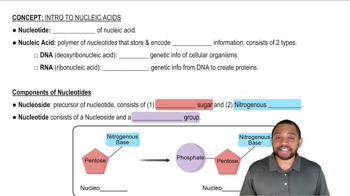
Nucleic acids, including DNA (deoxyribonucleic acid) and RNA (ribonucleic acid), are essential biomolecules that store and transmit genetic information. DNA is typically double-stranded and contains the genetic blueprint for living organisms, while RNA is usually single-stranded and plays a crucial role in protein synthesis and gene expression.
Recommended video:
Guided course
1:55
Intro to Nucleic Acids Concept 1

Nitrogenous Bases

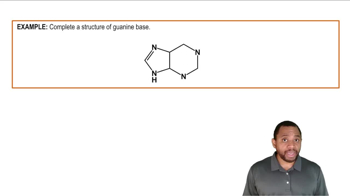
Both DNA and RNA are composed of nitrogenous bases, which are critical for encoding genetic information. DNA contains adenine (A), thymine (T), cytosine (C), and guanine (G), while RNA contains adenine (A), uracil (U), cytosine (C), and guanine (G). The presence of uracil in RNA instead of thymine is a key distinction between the two nucleic acids.
Recommended video:
Guided course
1:23
Nitrogenous Bases Example 3

Uracil

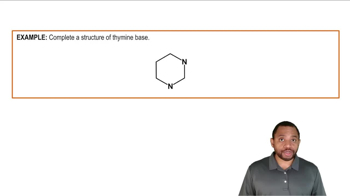
Uracil is a nitrogenous base found exclusively in RNA, where it pairs with adenine during the formation of RNA strands. Unlike thymine, which is present in DNA, uracil plays a vital role in the structure and function of RNA, particularly in processes like transcription and translation, where it helps in the synthesis of proteins.
Recommended video:
Guided course
1:57
Nitrogenous Bases Example 2