Pearson+ LogoPearson+ Logo
Ch.17 Nucleic Acids and Protein Synthesis
Timberlake - Chemistry: An Introduction to General, Organic, and Biological Chemistry 13th Edition
Timberlake13th EditionChemistry: An Introduction to General, Organic, and Biological ChemistryISBN: 9780134421353Not the one you use?Change textbook
Chapter 17, Problem 8b

Identify each of the following as a nucleoside or a nucleotide:
b. guanosine

Verified step by step guidance
1
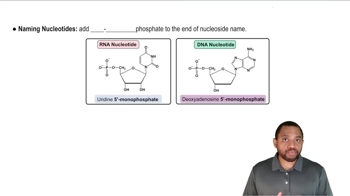
Understand the difference between a nucleoside and a nucleotide: A nucleoside consists of a nitrogenous base (purine or pyrimidine) attached to a sugar (ribose or deoxyribose), while a nucleotide is a nucleoside with one or more phosphate groups attached to the sugar.
Identify the components of guanosine: Guanosine is composed of the nitrogenous base guanine and the sugar ribose. There is no mention of any phosphate group in guanosine.
Determine whether guanosine is a nucleoside or a nucleotide: Since guanosine contains only a nitrogenous base and a sugar, and lacks any phosphate groups, it is classified as a nucleoside.
Recall the naming convention: Nucleosides that include purine bases (adenine or guanine) are named with the suffix '-osine,' such as guanosine, while those with pyrimidine bases (cytosine, thymine, or uracil) use the suffix '-idine.' This further confirms guanosine is a nucleoside.
Conclude the classification: Based on the absence of phosphate groups and the naming convention, guanosine is identified as a nucleoside.

Verified video answer for a similar problem:

This video solution was recommended by our tutors as helpful for the problem above.
Video duration:
3m
Was this helpful?

Key Concepts

Here are the essential concepts you must grasp in order to answer the question correctly.

Nucleosides

Nucleosides are organic molecules that consist of a nitrogenous base attached to a sugar molecule, specifically ribose in RNA or deoxyribose in DNA. They do not contain phosphate groups. Examples include adenosine, guanosine, cytidine, and uridine, which are formed when a nitrogenous base is linked to a sugar.
Recommended video:
Guided course
1:21
Naming Nucleosides and Nucleotides Concept 2

Nucleotides

Nucleotides are the building blocks of nucleic acids and consist of three components: a nitrogenous base, a sugar (ribose or deoxyribose), and one or more phosphate groups. They play crucial roles in cellular metabolism and energy transfer, with ATP (adenosine triphosphate) being a well-known example. Nucleotides can be formed by adding phosphate groups to nucleosides.
Recommended video:
Guided course
1:21
Naming Nucleosides and Nucleotides Concept 2

Guanosine

Guanosine is a specific type of nucleoside that consists of the nitrogenous base guanine attached to a ribose sugar. It is important in various biological processes, including serving as a building block for RNA. When a phosphate group is added to guanosine, it becomes guanosine monophosphate (GMP), a nucleotide.
Recommended video:
Guided course
1:36
Phase C - Oxaloacetate Regeneration Concept 7