Pearson+ LogoPearson+ Logo
Ch.17 Nucleic Acids and Protein Synthesis
Timberlake - Chemistry: An Introduction to General, Organic, and Biological Chemistry 13th Edition
Timberlake13th EditionChemistry: An Introduction to General, Organic, and Biological ChemistryISBN: 9780134421353Not the one you use?Change textbook
Chapter 17, Problem 12

In the genetic disease uridine monophosphate synthase deficiency, symptoms include anemia, cardiac malformations, and infections. Draw the condensed structural formula for uridine monophosphate.

Verified step by step guidance
1
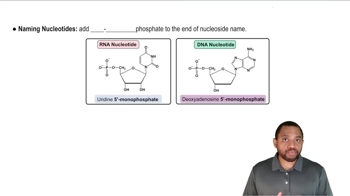
Understand the structure of uridine monophosphate (UMP): UMP is a nucleotide composed of three main components: a uracil base, a ribose sugar, and a phosphate group attached to the 5' carbon of the ribose.
Start with the uracil base: Uracil is a pyrimidine base with the molecular formula C₄H₄N₂O₂. It has a six-membered ring containing two nitrogen atoms and two keto groups at positions 2 and 4.
Attach the ribose sugar to the uracil base: The ribose sugar is a five-carbon sugar (C₅H₁₀O₅). In UMP, the ribose is in its β-furanose form, and it is connected to the uracil base via a β-N-glycosidic bond at the 1' carbon of the ribose and the nitrogen at position 1 of the uracil.
Add the phosphate group: The phosphate group (PO₄³⁻) is attached to the 5' carbon of the ribose sugar. This forms the monophosphate part of uridine monophosphate.
Combine all components into a condensed structural formula: Write the condensed structural formula by combining the uracil base, ribose sugar, and phosphate group in their proper connectivity. For example, the uracil base can be represented as part of the structure, the ribose as a sugar ring, and the phosphate group as -OPO₃²⁻ attached to the 5' carbon.

Verified video answer for a similar problem:

This video solution was recommended by our tutors as helpful for the problem above.
Video duration:
2m
Was this helpful?

Key Concepts

Here are the essential concepts you must grasp in order to answer the question correctly.

Uridine Monophosphate (UMP)

Uridine monophosphate (UMP) is a nucleotide that serves as a building block for RNA synthesis. It consists of a uracil base, a ribose sugar, and a single phosphate group. Understanding its structure is crucial for grasping its role in cellular processes and its implications in genetic diseases.
Recommended video:
Guided course
1:21
Naming Nucleosides and Nucleotides Concept 2

Condensed Structural Formula

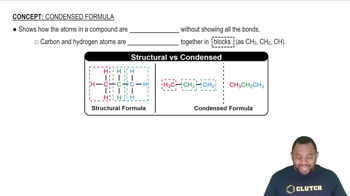
A condensed structural formula is a simplified representation of a chemical compound that shows the arrangement of atoms without depicting all the bonds explicitly. It provides a clear view of the molecular structure, making it easier to visualize how atoms are connected, which is essential for understanding the biochemical properties of UMP.
Recommended video:
Guided course
1:53
Condensed Formula Concept 1

Genetic Disease Mechanisms

Genetic diseases, such as uridine monophosphate synthase deficiency, arise from mutations that affect enzyme function, leading to metabolic disruptions. Understanding the underlying mechanisms of these diseases helps in identifying symptoms and potential treatments, emphasizing the importance of biochemical pathways in health and disease.
Recommended video:
Guided course
03:25
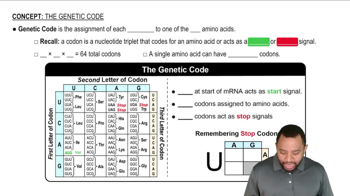
The Genetic Code Concept 1