
Pearson+ LogoPearson+ Logo
Ch.2 Chemistry and Measurements
Timberlake - Chemistry: An Introduction to General, Organic, and Biological Chemistry 13th Edition
Timberlake13th EditionChemistry: An Introduction to General, Organic, and Biological ChemistryISBN: 9780134421353Not the one you use?Change textbook
Chapter 2, Problem 11

In which of the following pairs do both numbers contain the same number of significant figures?
a. 11.0 m and 11.00 m
b. 0.0250 m and 0.205 m
c. 0.000 12 s and 12 000 s
d. 250.0 L and 2.5 × 10⁻² L

Verified step by step guidance
1
Step 1: Recall the rules for determining significant figures. Significant figures include all non-zero digits, any zeros between significant digits, and trailing zeros in a decimal number. Leading zeros are not significant.
Step 2: Analyze option (a): '11.0 m' has 3 significant figures because the trailing zero is significant in a decimal number. '11.00 m' has 4 significant figures because the two trailing zeros are significant. These do not have the same number of significant figures.
Step 3: Analyze option (b): '0.0250 m' has 3 significant figures because the leading zeros are not significant, but the trailing zero is. '0.205 m' also has 3 significant figures because the leading zero is not significant, but all other digits are. These have the same number of significant figures.
Step 4: Analyze option (c): '0.000 12 s' has 2 significant figures because the leading zeros are not significant. '12 000 s' has 2 significant figures if written without a decimal point, but it could have more if written with a decimal point (e.g., '12 000.' would have 5 significant figures). Without additional context, these do not necessarily have the same number of significant figures.
Step 5: Analyze option (d): '250.0 L' has 4 significant figures because the trailing zero is significant in a decimal number. '2.5 x 10⁻² L' has 2 significant figures because only the digits in the coefficient are counted in scientific notation. These do not have the same number of significant figures.

Verified video answer for a similar problem:

This video solution was recommended by our tutors as helpful for the problem above.
Video duration:
2m
Was this helpful?

Key Concepts

Here are the essential concepts you must grasp in order to answer the question correctly.

Significant Figures

Significant figures are the digits in a number that contribute to its precision. This includes all non-zero digits, any zeros between significant digits, and trailing zeros in the decimal portion. Understanding significant figures is crucial for accurately reporting measurements and ensuring that calculations reflect the precision of the data.
Recommended video:
Guided course
01:09
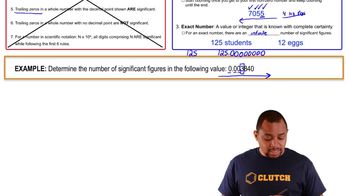
Significant Figures (Simplified) Example 2

Rules for Counting Significant Figures

There are specific rules for determining the number of significant figures in a number. For example, leading zeros are not counted, while trailing zeros in a decimal number are significant. Knowing these rules helps in comparing the significant figures of different numbers, which is essential for the question at hand.
Recommended video:
Guided course
01:09
Significant Figures (Simplified) Example 2

Scientific Notation

Scientific notation is a way of expressing numbers that are too large or too small in a compact form, using powers of ten. It helps in clearly indicating the number of significant figures, especially when dealing with very small or very large values. Understanding how to interpret numbers in scientific notation is important for evaluating significant figures in the context of the question.
Recommended video:
Guided course
01:41
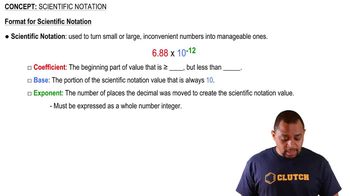
Scientific Notation