What amino acid is coded for by each of the following mRNA codons? c. CGG
Verified step by step guidance
1
Understand the problem: The question asks us to determine the amino acid coded by the mRNA codon CGG. To solve this, we need to use the genetic code, which maps mRNA codons to their corresponding amino acids.
Recall the structure of codons: Codons are sequences of three nucleotides in mRNA that specify a particular amino acid. Each codon is read in the 5' to 3' direction.
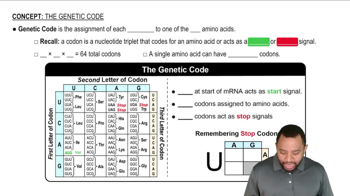
Use the genetic code chart: Locate the codon CGG in the genetic code chart. The first nucleotide (C) corresponds to the row, the second nucleotide (G) corresponds to the column, and the third nucleotide (G) helps refine the specific amino acid.
Identify the amino acid: According to the genetic code, the codon CGG codes for the amino acid arginine (Arg).
Conclude the solution: The mRNA codon CGG specifies the amino acid arginine (Arg). This process demonstrates how the genetic code translates nucleotide sequences into proteins.
Verified video answer for a similar problem:
This video solution was recommended by our tutors as helpful for the problem above
Video duration:
28s
Play a video:
Was this helpful?
Key Concepts
Here are the essential concepts you must grasp in order to answer the question correctly.
mRNA Codons
mRNA codons are sequences of three nucleotides in messenger RNA that correspond to specific amino acids or stop signals during protein synthesis. Each codon is read by the ribosome during translation, and the sequence of codons determines the order of amino acids in a protein. Understanding codons is essential for decoding genetic information and translating it into functional proteins.
Amino acids are organic compounds that serve as the building blocks of proteins. There are 20 standard amino acids, each with a unique side chain that determines its properties and role in protein structure and function. The sequence of amino acids in a protein is dictated by the corresponding mRNA codons, making the understanding of amino acids crucial for molecular biology and genetics.
The genetic code is the set of rules by which information encoded in mRNA is translated into proteins. It consists of 64 codons that specify the 20 amino acids and includes start and stop signals for protein synthesis. The genetic code is nearly universal among all organisms, highlighting its fundamental role in biology and the continuity of life.