Pearson+ LogoPearson+ Logo
Ch.11 Introduction to Organic Chemistry: Hydrocarbons
Timberlake - Chemistry: An Introduction to General, Organic, and Biological Chemistry 13th Edition
Timberlake13th EditionChemistry: An Introduction to General, Organic, and Biological ChemistryISBN: 9780134421353Not the one you use?Change textbook
Chapter 11, Problem 31a

Draw the condensed structural formula for each of the following:
a. trans-1-bromo-2-chloroethene

Verified step by step guidance
1
Step 1: Understand the structure of ethene (C₂H₄), which is a two-carbon molecule with a double bond between the carbons. The double bond restricts rotation, making it possible to have cis and trans isomers.
Step 2: Recognize that 'trans' means the substituents are on opposite sides of the double bond. In this case, the substituents are bromine (Br) and chlorine (Cl).
Step 3: Assign the substituents to the correct carbons. Bromine (Br) is attached to one carbon, and chlorine (Cl) is attached to the other carbon. Ensure they are positioned on opposite sides of the double bond to satisfy the 'trans' configuration.
Step 4: Write the condensed structural formula. Start with the carbon backbone (C=C), then add the substituents. For the trans configuration, one carbon will have Br and H, while the other will have Cl and H. Arrange them to reflect the opposite sides of the double bond.
Step 5: Combine everything into the condensed structural formula. The result should look like: HBrC=CHCl, where Br and Cl are on opposite sides of the double bond.

Verified video answer for a similar problem:

This video solution was recommended by our tutors as helpful for the problem above.
Was this helpful?

Key Concepts

Here are the essential concepts you must grasp in order to answer the question correctly.

Condensed Structural Formula

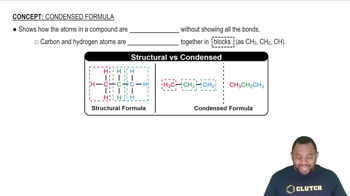
A condensed structural formula is a way of representing a chemical compound that shows the arrangement of atoms and the connectivity between them without depicting all the bonds explicitly. It typically uses symbols for atoms and groups them to indicate how they are connected, making it easier to visualize the structure of the molecule in a compact form.
Recommended video:
Guided course
1:53
Condensed Formula Concept 1

Geometric Isomerism

Geometric isomerism occurs in compounds with restricted rotation around a double bond, leading to different spatial arrangements of atoms. In the case of trans-1-bromo-2-chloroethene, the 'trans' designation indicates that the bromine and chlorine substituents are on opposite sides of the double bond, which affects the compound's physical and chemical properties.
Recommended video:
Guided course
01:50
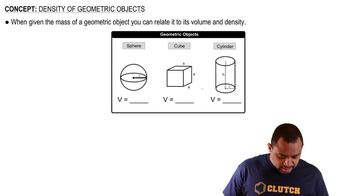
Density of Geometric Objects Concept

Nomenclature of Organic Compounds

The nomenclature of organic compounds follows specific rules set by the International Union of Pure and Applied Chemistry (IUPAC). For trans-1-bromo-2-chloroethene, the name indicates the presence of a double bond (ethene), the positions of the substituents (1 and 2), and the types of substituents (bromo and chloro), which are essential for accurately drawing its structure.
Recommended video:
Guided course
2:26
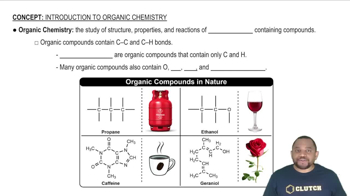
Introduction to Organic Chemistry Concept 1