Pearson+ LogoPearson+ Logo
Ch.11 Introduction to Organic Chemistry: Hydrocarbons
Timberlake - Chemistry: An Introduction to General, Organic, and Biological Chemistry 13th Edition
Timberlake13th EditionChemistry: An Introduction to General, Organic, and Biological ChemistryISBN: 9780134421353Not the one you use?Change textbook
Chapter 11, Problem 32b

Draw the condensed structural formula for each of the following:
b. trans-2-pentene

Verified step by step guidance
1
Step 1: Understand the structure of trans-2-pentene. 'Pentene' indicates a five-carbon alkene, and '2' specifies that the double bond is located between the second and third carbons in the chain. 'Trans' means the substituents on either side of the double bond are on opposite sides.
Step 2: Begin by drawing the backbone of the molecule, which consists of five carbon atoms connected in a straight chain. Label the carbons as C1, C2, C3, C4, and C5.
Step 3: Place the double bond between C2 and C3. Ensure that the double bond is clearly indicated in the structure.
Step 4: Add hydrogen atoms to each carbon to satisfy the valency of carbon (four bonds per carbon atom). For the trans configuration, place the hydrogen atoms on C2 and C3 on opposite sides of the double bond.
Step 5: Write the condensed structural formula by grouping the atoms bonded to each carbon. For example, C1 will have three hydrogens (CH3), C2 will have one hydrogen and a double bond to C3 (CH), and so on. Ensure the trans configuration is reflected in the formula.

Verified video answer for a similar problem:

This video solution was recommended by our tutors as helpful for the problem above.
Was this helpful?

Key Concepts

Here are the essential concepts you must grasp in order to answer the question correctly.

Condensed Structural Formula

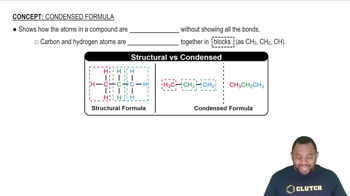
A condensed structural formula is a way of representing a chemical compound that shows the arrangement of atoms and the connectivity between them without depicting all the bonds explicitly. It simplifies the structure by grouping atoms together, often indicating the number of hydrogen atoms attached to each carbon atom. This format is particularly useful for organic compounds, allowing for a clearer understanding of their structure and composition.
Recommended video:
Guided course
1:53
Condensed Formula Concept 1

Trans Isomerism

Trans isomerism is a type of geometric isomerism where substituents are positioned on opposite sides of a double bond or a ring structure. In the case of alkenes like trans-2-pentene, this configuration affects the physical and chemical properties of the compound, such as boiling point and reactivity. Understanding trans isomerism is crucial for accurately drawing and interpreting the structure of compounds with double bonds.
Recommended video:
Guided course
1:26
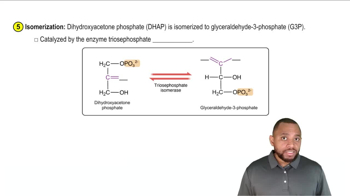
Glycolysis Concept 5

Pentene Structure

Pentene refers to a class of alkenes with five carbon atoms and at least one double bond. The '2' in trans-2-pentene indicates that the double bond is located between the second and third carbon atoms in the chain. Recognizing the basic structure of pentene is essential for constructing its condensed structural formula, as it provides the framework for identifying how the atoms are arranged and how they interact with one another.
Recommended video:
Guided course
1:01
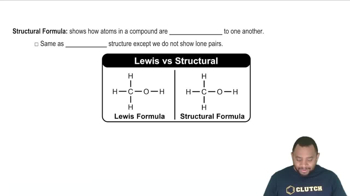
Structural Formula Concept 2