Pearson+ LogoPearson+ Logo
Ch.11 Introduction to Organic Chemistry: Hydrocarbons
Timberlake - Chemistry: An Introduction to General, Organic, and Biological Chemistry 13th Edition
Timberlake13th EditionChemistry: An Introduction to General, Organic, and Biological ChemistryISBN: 9780134421353Not the one you use?Change textbook
Chapter 11, Problem 66b

Draw the condensed structural or line-angle formula for the product of each of the following:
b. Condensed structural formula showing a hydrogenation reaction with reactants and nickel catalyst.

Verified step by step guidance
1
Step 1: Recognize the type of reaction. This is a hydrogenation reaction, where hydrogen (H₂) is added to an alkene in the presence of a catalyst (Ni in this case). The double bond in the alkene will be converted into a single bond, resulting in an alkane.
Step 2: Identify the structure of the reactant. The given reactant is CH₃—CH₂—CH₂—CH=CH₂, which is a five-carbon chain with a double bond between the fourth and fifth carbons.
Step 3: Determine the product of the reaction. During hydrogenation, the double bond (C=C) will break, and each carbon atom involved in the double bond will gain one hydrogen atom. This converts the double bond into a single bond (C-C).
Step 4: Write the condensed structural formula for the product. After the addition of hydrogen, the product will be a straight-chain alkane with no double bonds. Each carbon will have the appropriate number of hydrogens to satisfy the octet rule.
Step 5: Optionally, draw the line-angle formula for the product. In a line-angle formula, each vertex represents a carbon atom, and the hydrogens are implied. Since the product is a straight-chain alkane, the line-angle formula will be a simple zigzag line with no double or triple bonds.

Verified video answer for a similar problem:

This video solution was recommended by our tutors as helpful for the problem above.
Was this helpful?

Key Concepts

Here are the essential concepts you must grasp in order to answer the question correctly.

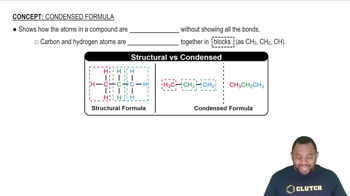
Condensed Structural Formula

A condensed structural formula is a way of representing a chemical compound that shows the arrangement of atoms and the connectivity between them without depicting all the bonds explicitly. It simplifies the structure by grouping atoms together, often using parentheses to indicate branching. This format is particularly useful for larger molecules, as it provides a clear overview of the molecular structure in a compact form.
Recommended video:
Guided course
1:53
Condensed Formula Concept 1

Line-Angle Formula

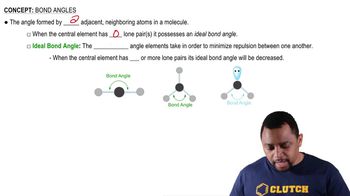
The line-angle formula, also known as the skeletal formula, is a shorthand representation of organic molecules where vertices represent carbon atoms and lines represent bonds. Hydrogen atoms attached to carbon are usually omitted for simplicity. This method allows chemists to visualize complex structures quickly and is especially useful for illustrating the connectivity and geometry of larger organic compounds.
Recommended video:
Guided course
01:24
Bond Angles (Simplified) Concept 1

Hydrogenation Reaction

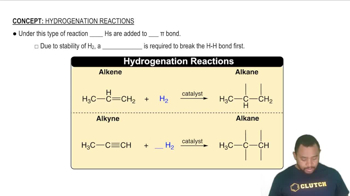
A hydrogenation reaction involves the addition of hydrogen (H₂) to an unsaturated compound, typically alkenes or alkynes, converting them into saturated hydrocarbons. This process is often catalyzed by metals such as nickel (Ni), which facilitate the reaction by providing a surface for the hydrogen to bond with the unsaturated carbon atoms. Understanding this reaction is crucial for predicting the products formed when alkenes react with hydrogen.
Recommended video:
Guided course
1:22
Hydrogenation Reactions Concept 1