Pearson+ LogoPearson+ Logo
Ch.11 Introduction to Organic Chemistry: Hydrocarbons
Timberlake - Chemistry: An Introduction to General, Organic, and Biological Chemistry 13th Edition
Timberlake13th EditionChemistry: An Introduction to General, Organic, and Biological ChemistryISBN: 9780134421353Not the one you use?Change textbook
Chapter 11, Problem 63a

Give the name for the product from the hydrogenation of each of the following:
a. 3-methyl-2-pentene

Verified step by step guidance
1
Identify the type of reaction: Hydrogenation is a reaction where hydrogen (H₂) is added to a molecule, typically across a double bond in an alkene, converting it into an alkane.
Locate the double bond in the given compound: In 3-methyl-2-pentene, the double bond is between carbon 2 and carbon 3 in the pentene chain.
Add hydrogen atoms across the double bond: During hydrogenation, one hydrogen atom will bond to each of the two carbons involved in the double bond, effectively removing the double bond and saturating the molecule.
Determine the resulting structure: After the double bond is removed, the compound becomes a fully saturated alkane. The name of the product will reflect this change, with the suffix '-ene' replaced by '-ane'.
Name the product: The resulting compound is 3-methylpentane, as the double bond is now replaced with single bonds, and the structure is fully saturated.

Verified video answer for a similar problem:

This video solution was recommended by our tutors as helpful for the problem above.
Was this helpful?

Key Concepts

Here are the essential concepts you must grasp in order to answer the question correctly.

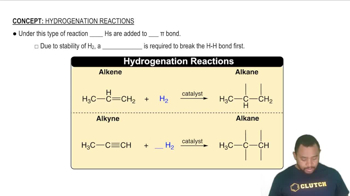
Hydrogenation

Hydrogenation is a chemical reaction that involves the addition of hydrogen (H2) to an unsaturated compound, typically an alkene or alkyne, resulting in the formation of a saturated compound. This process is commonly used in organic chemistry to convert double or triple bonds into single bonds, effectively increasing the hydrogen content of the molecule.
Recommended video:
Guided course
1:22
Hydrogenation Reactions Concept 1

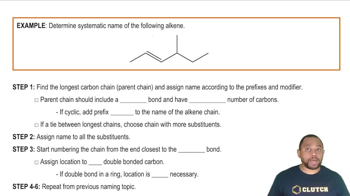
Alkenes

Alkenes are hydrocarbons that contain at least one carbon-carbon double bond (C=C). They are unsaturated compounds, which means they have fewer hydrogen atoms than alkanes, their saturated counterparts. The presence of the double bond makes alkenes more reactive than alkanes, allowing them to undergo various reactions, including hydrogenation.
Recommended video:
Guided course
3:26
Naming Alkenes Example 1

Product Identification

Identifying the product of a chemical reaction involves understanding the starting materials and the type of reaction taking place. In the case of hydrogenation of alkenes, the product is typically an alkane, which is a saturated hydrocarbon. The specific structure of the product can be determined by considering the original alkene's structure and how the addition of hydrogen affects it.
Recommended video:
Guided course
01:37
Solubility Product Constant (Ksp) Concept 2