Pearson+ LogoPearson+ Logo
Ch.11 Introduction to Organic Chemistry: Hydrocarbons
Timberlake - Chemistry: An Introduction to General, Organic, and Biological Chemistry 13th Edition
Timberlake13th EditionChemistry: An Introduction to General, Organic, and Biological ChemistryISBN: 9780134421353Not the one you use?Change textbook
Chapter 11, Problem 73a

Explosives used in mining contain TNT, or trinitrotoluene.
<IMAGE>
a. If the functional group nitro is ―NO2 draw the line-angle formula for 2,4,6-trinitrotoluene, one isomer of TNT.

Verified step by step guidance
1
Understand the structure of TNT: TNT stands for trinitrotoluene, which is a benzene ring with a methyl group (―CH₃) and three nitro groups (―NO₂) attached to it. The nitro groups are located at positions 2, 4, and 6 on the benzene ring relative to the methyl group.
Recall the line-angle formula: In a line-angle formula, each vertex represents a carbon atom, and hydrogen atoms bonded to carbons are implied but not shown explicitly. Functional groups like ―CH₃ and ―NO₂ are drawn explicitly.
Start with the benzene ring: Draw a hexagon to represent the benzene ring. Each corner of the hexagon represents a carbon atom.
Add the methyl group: Attach a ―CH₃ group to one of the carbons on the benzene ring. This is the toluene part of the molecule.
Add the nitro groups: Attach three ―NO₂ groups to the benzene ring at positions 2, 4, and 6 relative to the methyl group. These positions are opposite and symmetrical around the ring.

Verified video answer for a similar problem:

This video solution was recommended by our tutors as helpful for the problem above.
Was this helpful?

Key Concepts

Here are the essential concepts you must grasp in order to answer the question correctly.

Line-Angle Formula

The line-angle formula, also known as the skeletal formula, is a simplified way of representing organic molecules. In this representation, vertices and ends of lines represent carbon atoms, while other atoms, such as hydrogen, are often omitted for clarity. This method allows chemists to visualize the structure of complex molecules quickly and efficiently, focusing on functional groups and connectivity.
Recommended video:
Guided course
01:24
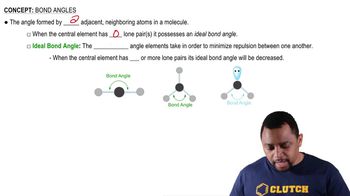
Bond Angles (Simplified) Concept 1

Functional Groups

Functional groups are specific groups of atoms within molecules that are responsible for the characteristic chemical reactions of those molecules. The nitro group (―NO₂) is a common functional group in organic chemistry, known for its role in explosives and pharmaceuticals. Understanding functional groups is essential for predicting the behavior and reactivity of organic compounds.
Recommended video:
Guided course
1:11
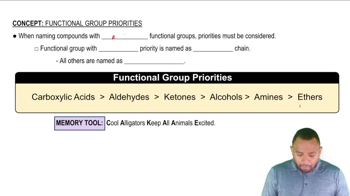
Functional Group Priorities Concept 1

Isomers

Isomers are compounds that have the same molecular formula but different structural arrangements of atoms. In the case of trinitrotoluene (TNT), isomers can differ in the position of the nitro groups on the benzene ring. Recognizing isomers is crucial in chemistry as they can exhibit vastly different physical and chemical properties despite having the same composition.
Recommended video:
Guided course
2:16
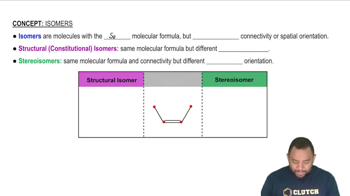
Isomers Concept 1