Pearson+ LogoPearson+ Logo
Ch.12 Alcohols, Thiols, Ethers, Aldehydes, and Ketones
Timberlake - Chemistry: An Introduction to General, Organic, and Biological Chemistry 13th Edition
Timberlake13th EditionChemistry: An Introduction to General, Organic, and Biological ChemistryISBN: 9780134421353Not the one you use?Change textbook
Chapter 12, Problem 6a

Give the common name for each of the following:
a. CH3−CH2−O−CH2−CH2−CH3

Verified step by step guidance
1
Step 1: Recognize the functional group present in the compound. The structure CH₃−CH₂−O−CH₂−CH₂−CH₃ contains an oxygen atom bonded to two alkyl groups, which identifies it as an ether.
Step 2: Recall the naming convention for ethers. In common naming, ethers are named by listing the names of the two alkyl groups attached to the oxygen atom in alphabetical order, followed by the word 'ether'.
Step 3: Identify the two alkyl groups in the compound. The group on the left of the oxygen atom is CH₃−CH₂− (ethyl group), and the group on the right is CH₂−CH₂−CH₃ (propyl group).
Step 4: Arrange the alkyl groups alphabetically. 'Ethyl' comes before 'propyl' alphabetically.
Step 5: Combine the names of the alkyl groups with the word 'ether' to form the common name. The common name of the compound is 'ethyl propyl ether'.

Verified video answer for a similar problem:

This video solution was recommended by our tutors as helpful for the problem above.
Was this helpful?

Key Concepts

Here are the essential concepts you must grasp in order to answer the question correctly.

Ether

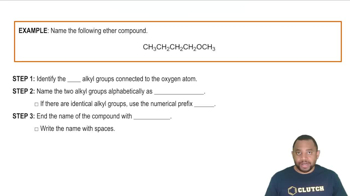
An ether is a class of organic compounds characterized by an oxygen atom connected to two alkyl or aryl groups. In the given molecular structure, the presence of the -O- group between two carbon chains indicates that it is an ether. Ethers are commonly used as solvents and in the synthesis of various chemical compounds.
Recommended video:
Guided course
1:15
Naming Ethers Example 1

Alkyl Groups

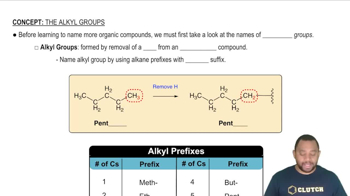
Alkyl groups are derived from alkanes by removing one hydrogen atom, resulting in a group of carbon and hydrogen atoms that can attach to other molecules. In the provided structure, the two carbon chains (CH₃−CH₂− and CH₂−CH₂−CH₃) represent alkyl groups that flank the ether oxygen. Understanding alkyl groups is essential for naming and identifying organic compounds.
Recommended video:
Guided course
2:26
Alkyl Groups Concept 1

IUPAC Nomenclature

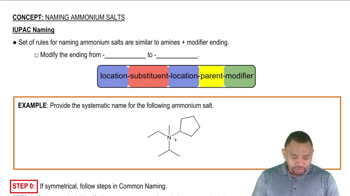
IUPAC nomenclature is a systematic method for naming chemical compounds based on their structure and functional groups. For ethers, the naming convention typically involves identifying the alkyl groups attached to the oxygen and combining their names with 'ether.' In this case, the compound can be named as ethyl propyl ether, reflecting the two alkyl groups present.
Recommended video:
Guided course
3:18
IUPAC Naming Concept 3