Pearson+ LogoPearson+ Logo
Ch.12 Alcohols, Thiols, Ethers, Aldehydes, and Ketones
Timberlake - Chemistry: An Introduction to General, Organic, and Biological Chemistry 13th Edition
Timberlake13th EditionChemistry: An Introduction to General, Organic, and Biological ChemistryISBN: 9780134421353Not the one you use?Change textbook
Chapter 12, Problem 16a

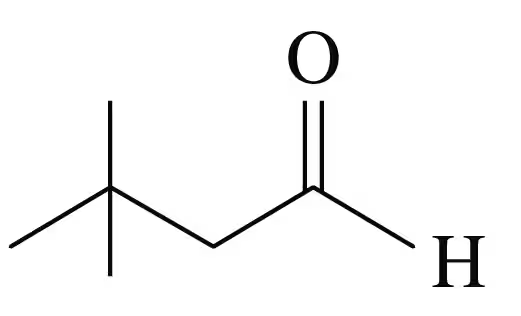
Identify each of the following compounds as an aldehyde or a ketone:
a. Chemical structure of an aldehyde with a carbonyl group and a hydroxyl group, labeled with hydrogen atoms.

Verified step by step guidance
1
Step 1: Understand the structural difference between aldehydes and ketones. Aldehydes have a carbonyl group (C=O) bonded to at least one hydrogen atom, while ketones have a carbonyl group bonded to two carbon atoms.
Step 2: Examine the structure of the compound in the image provided. Look for the carbonyl group (C=O) and identify the atoms directly attached to the carbonyl carbon.
Step 3: If the carbonyl carbon is bonded to one hydrogen atom and one other group (either a carbon or hydrogen), the compound is an aldehyde. If the carbonyl carbon is bonded to two carbon atoms, the compound is a ketone.
Step 4: Use the information from Step 3 to classify the compound in the image as either an aldehyde or a ketone.
Step 5: Confirm your classification by reviewing the structure again to ensure the correct identification of the groups attached to the carbonyl carbon.

Verified video answer for a similar problem:

This video solution was recommended by our tutors as helpful for the problem above.
Was this helpful?

Key Concepts

Here are the essential concepts you must grasp in order to answer the question correctly.

Aldehyde

An aldehyde is an organic compound characterized by the presence of a carbonyl group (C=O) at the end of a carbon chain. The general formula for aldehydes is RCHO, where R represents a hydrocarbon group. Aldehydes are typically more reactive than ketones due to the carbonyl group's position, which makes them susceptible to nucleophilic attack.
Recommended video:
Guided course
0:34
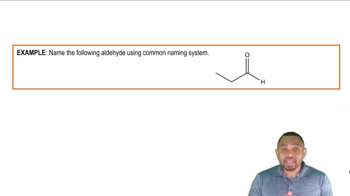
Naming Aldehydes Example 2

Ketone

A ketone is an organic compound that contains a carbonyl group (C=O) located within a carbon chain, specifically between two carbon atoms. The general formula for ketones is RC(=O)R', where R and R' can be the same or different hydrocarbon groups. Ketones are generally less reactive than aldehydes and are commonly found in various biological and industrial processes.
Recommended video:
Guided course
1:29
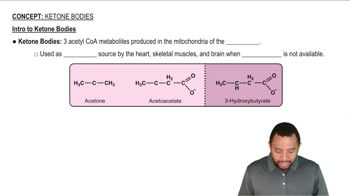
Ketone Bodies Concept 1

Carbonyl Group

The carbonyl group is a functional group consisting of a carbon atom double-bonded to an oxygen atom (C=O). It is a key feature in both aldehydes and ketones, influencing their chemical properties and reactivity. The position of the carbonyl group determines whether a compound is classified as an aldehyde or a ketone, making it essential for identifying these compounds.
Recommended video:
Guided course
1:00
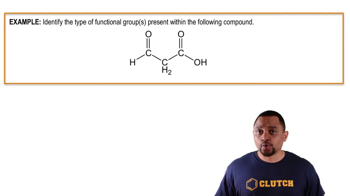
Functional Groups with Carbonyls Example 3