Pearson+ LogoPearson+ Logo
Ch.13 Carbohydrates
Timberlake - Chemistry: An Introduction to General, Organic, and Biological Chemistry 13th Edition
Timberlake13th EditionChemistry: An Introduction to General, Organic, and Biological ChemistryISBN: 9780134421353Not the one you use?Change textbook
Chapter 13, Problem 17a

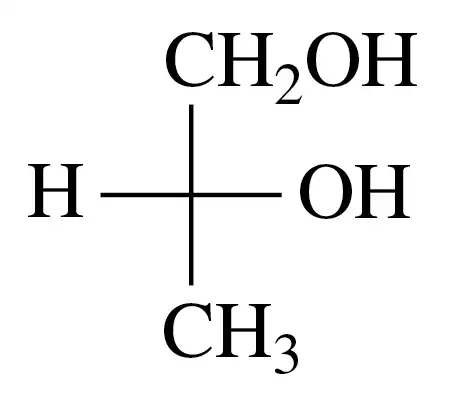
Identify each of the following as D or L:
a. Structural formula of a carbohydrate showing hydroxyl groups and hydrogen atoms for identifying D or L enantiomers.

Verified step by step guidance
1
Step 1: Understand the D and L notation. The D and L system is used to describe the configuration of chiral molecules, particularly sugars and amino acids. It is based on the molecule's relationship to glyceraldehyde, the simplest chiral sugar. D and L do not refer to the direction of optical rotation but to the spatial arrangement of groups around the chiral carbon.
Step 2: Locate the chiral carbon farthest from the carbonyl group (C=O) in the molecule. This carbon is the reference point for determining whether the molecule is D or L.
Step 3: Examine the orientation of the hydroxyl group (-OH) attached to the reference chiral carbon. If the -OH group is on the right side of the Fischer projection, the molecule is classified as D. If the -OH group is on the left side, the molecule is classified as L.
Step 4: Carefully analyze the Fischer projection of the molecule provided in the image. Identify the position of the -OH group on the reference chiral carbon.
Step 5: Based on the position of the -OH group, assign the molecule as either D or L. If the -OH is on the right, it is D; if it is on the left, it is L.

Verified video answer for a similar problem:

This video solution was recommended by our tutors as helpful for the problem above.
Video duration:
1m
Was this helpful?

Key Concepts

Here are the essential concepts you must grasp in order to answer the question correctly.

D and L Stereochemistry

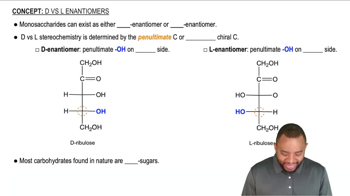
D and L refer to the stereochemical configuration of molecules, particularly amino acids and sugars. 'D' (dextrorotatory) indicates that a molecule rotates plane-polarized light to the right, while 'L' (levorotatory) indicates a leftward rotation. This classification is based on the molecule's relationship to glyceraldehyde, with D and L designations corresponding to the orientation of the hydroxyl group on the penultimate carbon.
Recommended video:
Guided course
1:30
D vs L Enantiomers Concept 1

Chirality

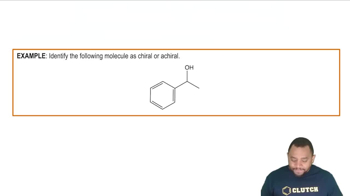
Chirality is a property of a molecule that makes it non-superimposable on its mirror image, much like left and right hands. Chiral molecules often exist in two forms, known as enantiomers, which can have different biological activities. Understanding chirality is crucial for determining the D or L configuration of a compound, as it influences how the molecule interacts with biological systems.
Recommended video:
Guided course
1:39
Chirality Example 1

Fischer Projection

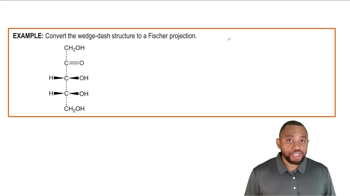
The Fischer projection is a two-dimensional representation of a three-dimensional organic molecule, commonly used for sugars and amino acids. In this format, the vertical lines represent bonds going back in space, while horizontal lines represent bonds coming forward. This method simplifies the visualization of stereochemistry, making it easier to identify whether a compound is in the D or L configuration based on the orientation of its functional groups.
Recommended video:
Guided course
0:48
Fischer Projections Example 1