Pearson+ LogoPearson+ Logo
Ch.13 Carbohydrates
Timberlake - Chemistry: An Introduction to General, Organic, and Biological Chemistry 13th Edition
Timberlake13th EditionChemistry: An Introduction to General, Organic, and Biological ChemistryISBN: 9780134421353Not the one you use?Change textbook
Chapter 13, Problem 76

The disaccharide trehalose found in mushrooms is composed of two α-D-glucose molecules joined by an α(1→1)−glycosidic bond. Draw the Haworth structure for trehalose.

Verified step by step guidance
1
Understand the structure of α-D-glucose: Begin by recalling the Haworth structure of α-D-glucose. It is a six-membered ring (pyranose form) with the hydroxyl group (-OH) on carbon-1 pointing downward (α-anomer).
Identify the glycosidic bond: The problem states that the two α-D-glucose molecules are joined by an α(1→1)-glycosidic bond. This means the bond is formed between the anomeric carbons (carbon-1) of both glucose molecules, with the oxygen atom acting as the bridge.
Draw the first glucose molecule: Start by sketching the Haworth structure of the first α-D-glucose molecule. Label the carbons (1 through 6) and ensure the -OH group on carbon-1 is pointing downward.
Connect the second glucose molecule: Draw the second α-D-glucose molecule in its Haworth form. Rotate it slightly so that its carbon-1 aligns with the carbon-1 of the first glucose. Use an oxygen atom to connect the two carbon-1 atoms, forming the α(1→1)-glycosidic bond.
Complete the structure: Ensure all other hydroxyl groups (-OH) and hydrogen atoms are correctly positioned on the glucose rings. Verify that the glycosidic bond is labeled as α(1→1) and that the overall structure represents trehalose.

Verified video answer for a similar problem:

This video solution was recommended by our tutors as helpful for the problem above.
Video duration:
1m
Was this helpful?

Key Concepts

Here are the essential concepts you must grasp in order to answer the question correctly.

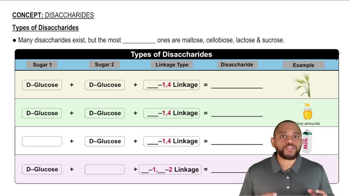
Disaccharides

Disaccharides are carbohydrates formed by the condensation of two monosaccharides, resulting in a glycosidic bond. In the case of trehalose, it consists of two α-d-glucose units linked together. Understanding disaccharides is essential for grasping how they function in biological systems and their structural properties.
Recommended video:
Guided course
3:39
Types of Disaccharides Concept 1

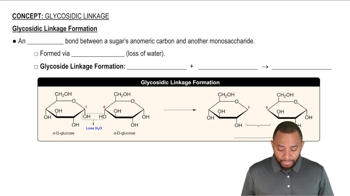
Glycosidic Bonds

A glycosidic bond is a type of covalent bond that connects a carbohydrate molecule to another group, which can be another carbohydrate. The specific type of glycosidic bond in trehalose is α(1→1), indicating the orientation and position of the bond between the glucose units. This bond is crucial for determining the properties and digestibility of the sugar.
Recommended video:
Guided course
1:44
Glycosidic Linkage Formation Concept 1

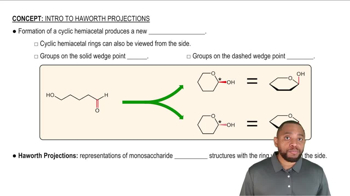
Haworth Structure

The Haworth structure is a way of representing the cyclic form of carbohydrates, showing the arrangement of atoms in a ring. For trehalose, drawing its Haworth structure involves illustrating the two glucose units in their cyclic forms, including the anomeric carbons and the orientation of hydroxyl groups. This representation is vital for understanding the molecule's chemical behavior and interactions.
Recommended video:
Guided course
2:18
Intro to Haworth Projections Concept 1