Pearson+ LogoPearson+ Logo
Ch.13 Carbohydrates
Timberlake - Chemistry: An Introduction to General, Organic, and Biological Chemistry 13th Edition
Timberlake13th EditionChemistry: An Introduction to General, Organic, and Biological ChemistryISBN: 9780134421353Not the one you use?Change textbook
Chapter 13, Problem 75

α−Cellobiose is a disaccharide obtained from the hydrolysis of cellulose. It is quite similar to maltose except it has a β(1→4)−glycosidic bond. Draw the Haworth structure for α−cellobiose.

Verified step by step guidance
1
Understand the structure of α-cellobiose: α-cellobiose is a disaccharide composed of two glucose units linked by a β(1→4)-glycosidic bond. This means the bond connects the anomeric carbon (C1) of one glucose molecule in the β-configuration to the C4 carbon of the second glucose molecule.
Recall the Haworth projection: The Haworth structure is a way to represent cyclic sugars. Glucose in its cyclic form is a six-membered ring (pyranose form). The α-anomer indicates that the hydroxyl group (-OH) on the anomeric carbon (C1) of the first glucose is pointing downward in the Haworth projection.
Draw the first glucose unit: Start by drawing a six-membered ring for the first glucose molecule. Place the -OH group on the anomeric carbon (C1) pointing downward (α-configuration). Arrange the other hydroxyl groups on C2, C3, and C4 according to the D-glucose configuration (C2 -OH down, C3 -OH up, C4 -OH down).
Draw the second glucose unit: Draw another six-membered ring for the second glucose molecule. This glucose is linked to the first glucose via a β(1→4)-glycosidic bond. The -OH group on the anomeric carbon (C1) of the second glucose is in the β-configuration (pointing upward). Arrange the other hydroxyl groups on C2, C3, and C4 as in the D-glucose configuration.
Connect the two glucose units: Link the C1 of the first glucose (in the α-configuration) to the C4 of the second glucose (in the β-configuration) via an oxygen atom to form the β(1→4)-glycosidic bond. Ensure the orientation of the rings and hydroxyl groups is consistent with the Haworth projection.

Verified video answer for a similar problem:

This video solution was recommended by our tutors as helpful for the problem above.
Video duration:
2m
Was this helpful?

Key Concepts

Here are the essential concepts you must grasp in order to answer the question correctly.

Disaccharides

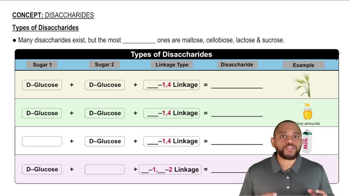
Disaccharides are carbohydrates formed by the condensation of two monosaccharide units, linked by a glycosidic bond. They play a crucial role in energy storage and supply in living organisms. Understanding the structure and function of disaccharides, such as α-cellobiose and maltose, is essential for studying carbohydrate chemistry.
Recommended video:
Guided course
3:39
Types of Disaccharides Concept 1

Glycosidic Bonds

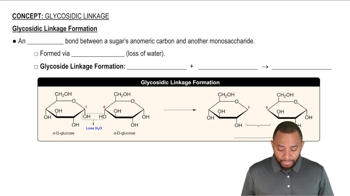
Glycosidic bonds are covalent linkages that connect monosaccharides to form disaccharides and polysaccharides. The type of glycosidic bond, such as α(1→4) or β(1→4), determines the properties and digestibility of the carbohydrate. In the case of α-cellobiose, the β(1→4) bond influences its structural characteristics and biological functions.
Recommended video:
Guided course
1:44
Glycosidic Linkage Formation Concept 1

Haworth Structure

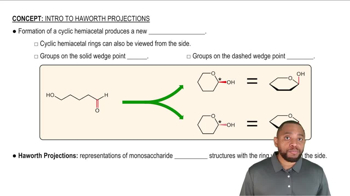
The Haworth structure is a cyclic representation of monosaccharides and disaccharides that illustrates their ring forms. This model helps visualize the orientation of hydroxyl groups and the anomeric carbon, which is crucial for understanding the reactivity and properties of sugars. Drawing the Haworth structure for α-cellobiose will clarify its molecular configuration and functional groups.
Recommended video:
Guided course
2:18
Intro to Haworth Projections Concept 1