Pearson+ LogoPearson+ Logo
Ch.13 Carbohydrates
Timberlake - Chemistry: An Introduction to General, Organic, and Biological Chemistry 13th Edition
Timberlake13th EditionChemistry: An Introduction to General, Organic, and Biological ChemistryISBN: 9780134421353Not the one you use?Change textbook
Chapter 13, Problem 72

D-Erythritol is 70% as sweet as sucrose and contains only hydroxyl functional groups. When d-erythritol is oxidized it forms D-erythrose. Draw the Fischer projection for D-erythritol.

Verified step by step guidance
1
Understand the structure of d-erythritol: d-erythritol is a sugar alcohol (polyol) with four carbon atoms, each containing a hydroxyl (-OH) group. It is derived from the reduction of the corresponding aldose sugar, d-erythrose.
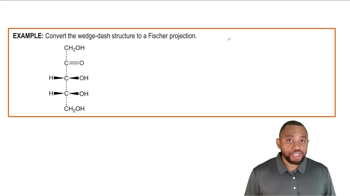
Recall the Fischer projection: A Fischer projection is a two-dimensional representation of a molecule where the carbon chain is drawn vertically, with the most oxidized carbon (in this case, the primary alcohol group) at the top. Horizontal lines represent bonds projecting out of the plane (toward the viewer), and vertical lines represent bonds projecting into the plane (away from the viewer).
Determine the stereochemistry of d-erythritol: d-erythritol is a meso compound, meaning it has internal symmetry and is achiral. The hydroxyl groups on the second and third carbons are on opposite sides of the carbon chain, creating a mirror image within the molecule.
Draw the Fischer projection: Start by placing the four carbon atoms in a vertical line. Attach hydroxyl (-OH) groups to each carbon, ensuring that the second carbon has the hydroxyl group on the right, the third carbon has the hydroxyl group on the left, and the first and fourth carbons have hydroxyl groups pointing vertically (up and down, respectively).
Verify the structure: Check that the Fischer projection accurately represents the meso structure of d-erythritol, with the correct placement of hydroxyl groups and the internal symmetry of the molecule.

Verified video answer for a similar problem:

This video solution was recommended by our tutors as helpful for the problem above.
Video duration:
1m
Was this helpful?

Key Concepts

Here are the essential concepts you must grasp in order to answer the question correctly.

Fischer Projection

The Fischer projection is a two-dimensional representation of a three-dimensional organic molecule, particularly useful for depicting carbohydrates and amino acids. In this format, the vertical lines represent bonds that are oriented away from the viewer, while horizontal lines indicate bonds that are coming towards the viewer. This method helps in visualizing the stereochemistry of molecules, making it easier to identify chiral centers and their configurations.
Recommended video:
Guided course
0:48
Fischer Projections Example 1

Hydroxyl Functional Groups

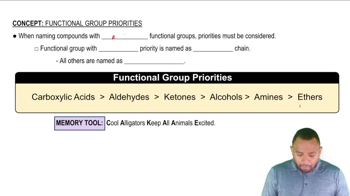
Hydroxyl functional groups (-OH) are characterized by the presence of an oxygen atom bonded to a hydrogen atom. They are polar and can form hydrogen bonds, which significantly influence the solubility and reactivity of organic compounds. In sugars like d-erythritol, hydroxyl groups contribute to the molecule's sweetness and its ability to participate in various chemical reactions, including oxidation.
Recommended video:
Guided course
1:11
Functional Group Priorities Concept 1

Oxidation of Alcohols

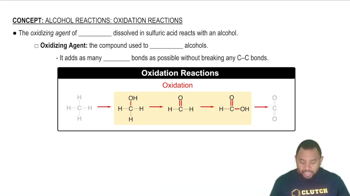
Oxidation of alcohols involves the conversion of hydroxyl groups into carbonyl groups, resulting in the formation of aldehydes or ketones. In the case of d-erythritol, oxidation leads to the formation of d-erythrose, a sugar with a different structure and properties. This transformation is significant in organic chemistry as it alters the functional groups and can change the biological activity and sweetness of the compound.
Recommended video:
Guided course
1:49
Alcohol Reactions: Oxidation Concept 1