Pearson+ LogoPearson+ Logo
Ch.13 Carbohydrates
Timberlake - Chemistry: An Introduction to General, Organic, and Biological Chemistry 13th Edition
Timberlake13th EditionChemistry: An Introduction to General, Organic, and Biological ChemistryISBN: 9780134421353Not the one you use?Change textbook
Chapter 13, Problem 73

If α−galactose is dissolved in water, β−galactose is eventually present. Explain how this occurs.

Verified step by step guidance
1
Understand that α-galactose and β-galactose are anomers, which are a type of stereoisomers differing in the configuration around the anomeric carbon (the carbon derived from the carbonyl group in the cyclic form of the sugar).
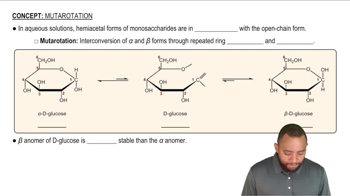
Recognize that when α-galactose is dissolved in water, it undergoes a process called mutarotation. Mutarotation is the interconversion between the α and β forms of a sugar through the open-chain form.
In water, the cyclic form of α-galactose can briefly open up to form its linear (open-chain) structure. This occurs because the glycosidic bond at the anomeric carbon is not fixed and can break in aqueous solution.
Once in the open-chain form, the molecule can reclose to form either the α or β anomer. The β form is created when the hydroxyl group on the anomeric carbon is positioned on the opposite side of the ring compared to the α form.
Over time, an equilibrium is established between the α and β forms of galactose in solution, with both forms present in specific proportions. This is why β-galactose is eventually present when α-galactose is dissolved in water.

Verified video answer for a similar problem:

This video solution was recommended by our tutors as helpful for the problem above.
Video duration:
3m
Was this helpful?

Key Concepts

Here are the essential concepts you must grasp in order to answer the question correctly.

Anomeric Carbon

The anomeric carbon is the carbon atom in a sugar molecule that is derived from the carbonyl carbon during the formation of a cyclic structure. In the case of galactose, this carbon can exist in two configurations: α and β. The interconversion between these forms is crucial for understanding how α-galactose can eventually lead to the presence of β-galactose in solution.
Recommended video:
Guided course
5:36
Amino Acid Catabolism: Carbon Atoms Concept 2

Mutarotation

Mutarotation is the process by which anomeric forms of sugars interconvert in solution, resulting in a change in optical rotation. When α-galactose is dissolved in water, it undergoes mutarotation, allowing it to convert to β-galactose. This dynamic equilibrium between the anomers is a key concept in carbohydrate chemistry.
Recommended video:
Guided course
2:10
Mutarotation Concept 1

Equilibrium in Solution

In a solution, chemical species can exist in dynamic equilibrium, where the rates of the forward and reverse reactions are equal. For α- and β-galactose, this means that while α-galactose can convert to β-galactose, the reverse reaction can also occur. Eventually, a stable ratio of both anomers is established, explaining the presence of β-galactose when α-galactose is dissolved in water.
Recommended video: