
Pearson+ LogoPearson+ Logo
Ch.14 Carboxylic Acids, Esters, Amines, and Amides
Timberlake - Chemistry: An Introduction to General, Organic, and Biological Chemistry 13th Edition
Timberlake13th EditionChemistry: An Introduction to General, Organic, and Biological ChemistryISBN: 9780134421353Not the one you use?Change textbook
Chapter 14, Problem 82a

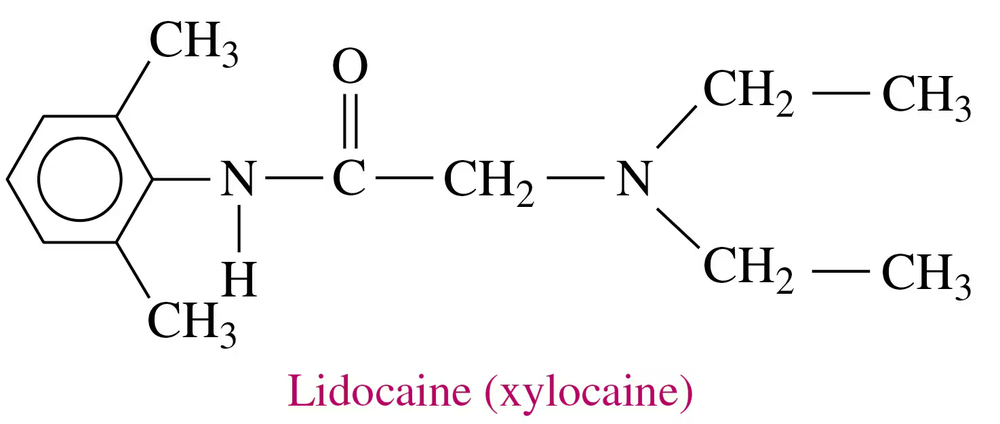
Lidocaine (xylocaine) is used as a local anesthetic and cardiac depressant.
Condensed structural formula of lidocaine, labeled as "Lidocaine (xylocaine)" in pink text.
a. Draw the condensed structural formula for the ammonium salt formed when lidocaine reacts with HCl.

Verified step by step guidance
1
Understand the problem: Lidocaine is a compound that contains an amine group (-NH2 or -NH). When an amine reacts with HCl (hydrochloric acid), it forms an ammonium salt. This reaction involves the protonation of the amine group.
Identify the functional group in lidocaine that will react with HCl. Look for the amine group in the structure of lidocaine, as this is the group that will accept a proton (H⁺) from HCl.
Write the reaction: The amine group in lidocaine reacts with HCl to form an ammonium ion. The general reaction is: R-NH2+HClR-NH3+Cl-, where R represents the rest of the molecule.
Draw the condensed structural formula: Replace the amine group (-NH2 or -NH) in lidocaine with the ammonium ion (-NH3⁺) and add the chloride ion (Cl⁻) to represent the salt. Ensure that the rest of the lidocaine structure remains unchanged.
Verify the structure: Double-check that the ammonium salt structure you have drawn is consistent with the reaction and that all atoms and charges are correctly represented.

Verified video answer for a similar problem:

This video solution was recommended by our tutors as helpful for the problem above.
Video duration:
5m
Was this helpful?

Key Concepts

Here are the essential concepts you must grasp in order to answer the question correctly.

Lidocaine Structure

Lidocaine is an amide local anesthetic with a specific chemical structure that includes an aromatic ring, an amine group, and an amide linkage. Understanding its structure is crucial for predicting how it interacts with acids like HCl to form an ammonium salt.
Recommended video:
Guided course
1:01
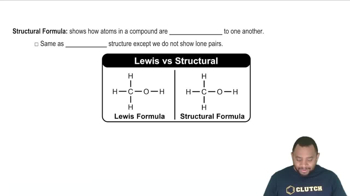
Structural Formula Concept 2

Ammonium Salts

Ammonium salts are formed when an amine reacts with an acid, resulting in the protonation of the amine group. In the case of lidocaine, the nitrogen atom in the amine group accepts a proton from HCl, leading to the formation of a positively charged ammonium ion.
Recommended video:
Guided course
1:04
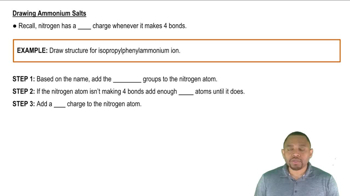
Drawing Ammonium Salts Concept 2

Condensed Structural Formula

A condensed structural formula provides a simplified representation of a molecule, showing the arrangement of atoms without depicting all the bonds explicitly. For lidocaine's ammonium salt, this formula will illustrate the protonated amine and the associated chloride ion, reflecting the compound's ionic nature.
Recommended video:
Guided course
1:53
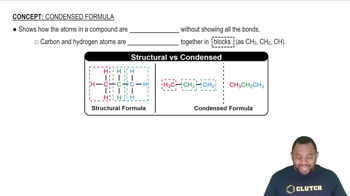
Condensed Formula Concept 1