Pearson+ LogoPearson+ Logo
Ch.14 Carboxylic Acids, Esters, Amines, and Amides
Timberlake - Chemistry: An Introduction to General, Organic, and Biological Chemistry 13th Edition
Timberlake13th EditionChemistry: An Introduction to General, Organic, and Biological ChemistryISBN: 9780134421353Not the one you use?Change textbook
Chapter 14, Problem 79b

Propyl acetate is the ester that gives the odor and smell of pears.
<IMAGE>
b. Write the balanced chemical equation for the formation of propyl acetate.

Verified step by step guidance
1
Identify the reactants involved in the formation of propyl acetate. Esters like propyl acetate are typically formed through a reaction between a carboxylic acid and an alcohol. In this case, the carboxylic acid is acetic acid (CH₃COOH), and the alcohol is 1-propanol (CH₃CH₂CH₂OH).
Write the general reaction for esterification: RCOOH + R'OHRCOOR' + H2O. Here, R represents the alkyl group from the carboxylic acid, and R' represents the alkyl group from the alcohol.
Substitute the specific reactants into the general equation. For acetic acid (CH₃COOH) and 1-propanol (CH₃CH₂CH₂OH), the reaction becomes: CH3COOH + CH3CH2CH2OHCH3COOCHCH2CH2CH3 + H2O.
Balance the chemical equation. In this case, the equation is already balanced as written because the number of each type of atom is the same on both sides of the equation.
Verify the product. The ester formed is propyl acetate (CH₃COOCH₂CH₂CH₃), and water (H₂O) is the byproduct of the reaction. This confirms the balanced chemical equation for the formation of propyl acetate.

Verified video answer for a similar problem:

This video solution was recommended by our tutors as helpful for the problem above.
Video duration:
2m
Was this helpful?

Key Concepts

Here are the essential concepts you must grasp in order to answer the question correctly.

Esterification

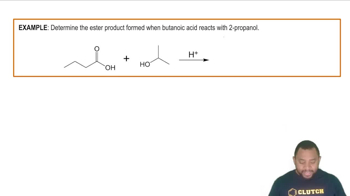
Esterification is a chemical reaction that forms an ester from an alcohol and a carboxylic acid. In this process, the hydroxyl group (-OH) from the acid and a hydrogen atom from the alcohol combine to release water (H2O), resulting in the formation of the ester. This reaction is typically catalyzed by an acid, which helps to drive the reaction to completion.
Recommended video:
Guided course
0:46
Ester Reactions: Esterification Example 1

Balanced Chemical Equation

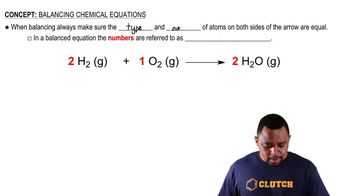
A balanced chemical equation represents a chemical reaction with equal numbers of each type of atom on both sides of the equation. Balancing ensures the law of conservation of mass is upheld, meaning that matter is neither created nor destroyed in the reaction. This is crucial for accurately depicting the reactants and products involved in the formation of compounds like propyl acetate.
Recommended video:
Guided course
01:32
Balancing Chemical Equations (Simplified) Concept 1

Propyl Acetate

Propyl acetate is an organic compound classified as an ester, formed from propanol (an alcohol) and acetic acid (a carboxylic acid). It is known for its fruity odor, reminiscent of pears, and is commonly used in the food and fragrance industries. Understanding its structure and formation is essential for writing the correct balanced chemical equation for its synthesis.
Recommended video:
Guided course
2:17
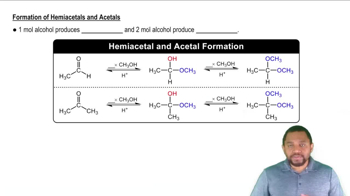
Formation of Hemiacetals and Acetals Concept 2