Use condensed structural formulas to write the balanced chemical equation for the hydrogenation of glyceryl trilinolenate, a fat containing glycerol and three linolenic acid molecules.
Ch.15 Lipids
Timberlake13th EditionChemistry: An Introduction to General, Organic, and Biological ChemistryISBN: 9780134421353Not the one you use?Change textbook
Chapter 15, Problem 39
Describe the similarities and differences between triacylglycerols and glycerophospholipids.
Verified step by step guidance1
Triacylglycerols and glycerophospholipids are both lipids derived from glycerol, which serves as the backbone for their structure. Begin by identifying the common structural feature: both molecules contain a glycerol backbone to which fatty acids are attached via ester bonds.
Triacylglycerols consist of three fatty acid chains attached to the three hydroxyl groups of glycerol. This makes them nonpolar and hydrophobic, meaning they are not soluble in water. They are primarily used for energy storage in the body.
Glycerophospholipids, on the other hand, have two fatty acid chains attached to the first two hydroxyl groups of glycerol, while the third hydroxyl group is bonded to a phosphate group. This phosphate group is often further linked to a polar head group, such as choline or ethanolamine, making glycerophospholipids amphipathic (having both hydrophobic and hydrophilic regions).
The key difference lies in their function: triacylglycerols are primarily used for long-term energy storage, while glycerophospholipids are major components of cell membranes, contributing to their structure and function.
Summarize the similarities and differences: Both molecules share a glycerol backbone and fatty acid chains, but triacylglycerols are fully hydrophobic and used for energy storage, whereas glycerophospholipids are amphipathic and play a structural role in cell membranes.

Verified video answer for a similar problem:
This video solution was recommended by our tutors as helpful for the problem above.
Video duration:
3mWas this helpful?
Key Concepts
Here are the essential concepts you must grasp in order to answer the question correctly.
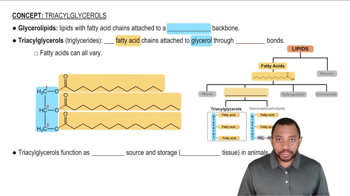
Triacylglycerols
Triacylglycerols, also known as triglycerides, are lipids composed of three fatty acid molecules esterified to a glycerol backbone. They serve primarily as energy storage molecules in adipose tissue and are a major component of dietary fats. Their structure allows for efficient energy storage, as they can be broken down into fatty acids and glycerol when energy is needed.
Recommended video:
Guided course
Triacylglycerols Concept 1
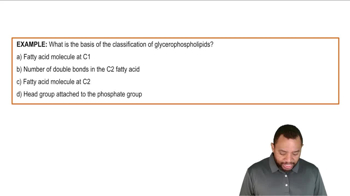
Glycerophospholipids
Glycerophospholipids are a class of lipids that consist of two fatty acids, a glycerol backbone, and a phosphate group. They are key components of cell membranes, providing structural integrity and fluidity. The presence of a phosphate group allows for the formation of hydrophilic (water-attracting) and hydrophobic (water-repelling) regions, which is crucial for membrane function.
Recommended video:
Guided course
Glycerophospholipids Example 2
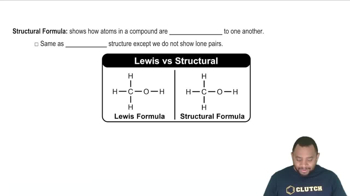
Structural Differences
The primary structural difference between triacylglycerols and glycerophospholipids lies in their composition. Triacylglycerols contain three fatty acids, while glycerophospholipids have only two fatty acids and a phosphate group. This difference in structure leads to distinct functions: triacylglycerols are mainly for energy storage, whereas glycerophospholipids are essential for forming cellular membranes.
Recommended video:
Guided course
Structural Formula Concept 2
Related Practice
Textbook Question
601
views
Textbook Question
Use line-angle formulas to write the balanced chemical equation for the acid hydrolysis of glyceryl trimyristate (trimyristin).
500
views
Textbook Question
Use condensed structural formulas to write the balanced chemical equation for the NaOH saponification of glyceryl trimyristate (trimyristin).
641
views
Textbook Question
Draw the condensed structural formula for the cephalin that contains glycerol, two palmitic acids, phosphate, and ethanolamine (ionized).
997
views
Textbook Question
Identify the following glycerophospholipid, which is found in the nerves and spinal cord in the body, as a lecithin or cephalin, and list its components:
855
views
Textbook Question
Identify the following features of this phospholipid, which is abundant in the myelin sheath that surrounds nerve cells:
b. What is the fatty acid?
621
views