Pearson+ LogoPearson+ Logo
Ch.15 Lipids
Timberlake - Chemistry: An Introduction to General, Organic, and Biological Chemistry 13th Edition
Timberlake13th EditionChemistry: An Introduction to General, Organic, and Biological ChemistryISBN: 9780134421353Not the one you use?Change textbook
Chapter 15, Problem 45b

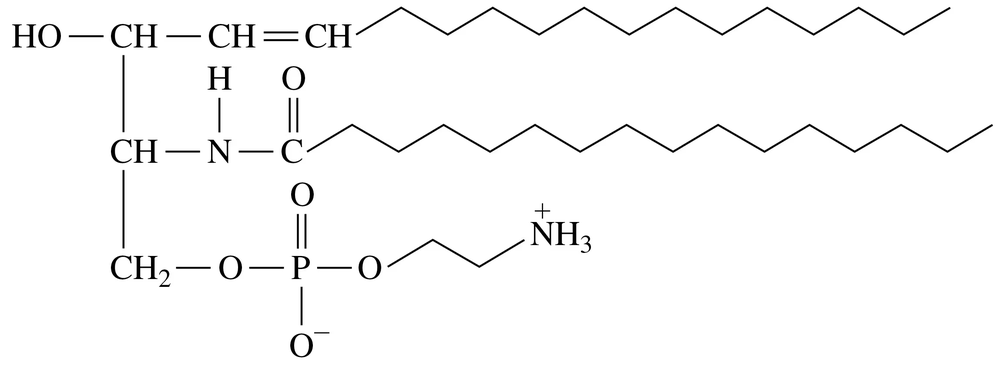
Identify the following features of this phospholipid, which is abundant in the myelin sheath that surrounds nerve cells:

b. What is the fatty acid?

Verified step by step guidance
1
Examine the structure of the phospholipid provided in the image. Identify the two hydrophobic tails attached to the glycerol backbone. These tails are typically derived from fatty acids.
Determine which of the two hydrophobic tails corresponds to the fatty acid. Fatty acids are long hydrocarbon chains with a carboxylic acid group (-COOH) at one end.
Analyze the chemical structure of the tail to confirm it is a fatty acid. Look for the absence of functional groups like phosphate or amine, which would indicate it is not a fatty acid.
Identify the specific fatty acid by counting the number of carbon atoms in the chain and noting the presence or absence of double bonds. This will help determine whether the fatty acid is saturated (no double bonds) or unsaturated (one or more double bonds).
Name the fatty acid based on its structure. Use the IUPAC naming system or common names if applicable (e.g., palmitic acid for a 16-carbon saturated fatty acid).

Verified video answer for a similar problem:

This video solution was recommended by our tutors as helpful for the problem above.
Video duration:
1m
Was this helpful?

Key Concepts

Here are the essential concepts you must grasp in order to answer the question correctly.

Phospholipid Structure

Phospholipids are molecules composed of a hydrophilic (water-attracting) 'head' and two hydrophobic (water-repelling) 'tails' made of fatty acids. This unique structure allows them to form bilayers, which are fundamental to cell membranes, including the myelin sheath that insulates nerve cells.
Recommended video:
Guided course
1:01
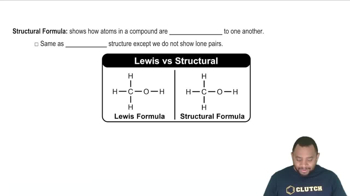
Structural Formula Concept 2

Fatty Acids

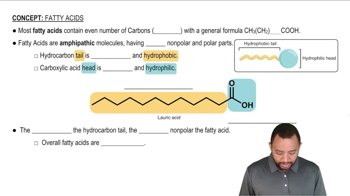
Fatty acids are long hydrocarbon chains that can be saturated (no double bonds) or unsaturated (one or more double bonds). They are key components of phospholipids, influencing membrane fluidity and functionality, particularly in the context of myelin, which is crucial for efficient nerve signal transmission.
Recommended video:
Guided course
2:00
Fatty Acids Concept 1

Myelin Sheath

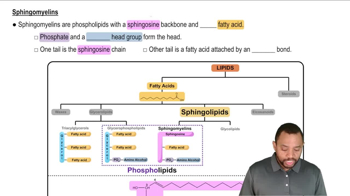
The myelin sheath is a protective layer that surrounds the axons of nerve cells, composed mainly of lipids, including phospholipids. This sheath enhances the speed of electrical impulses along the nerve fibers, playing a vital role in the nervous system's overall efficiency and functionality.
Recommended video:
Guided course
1:47
Sphingomyelins Concept 2