Pearson+ LogoPearson+ Logo
Ch.15 Lipids
Timberlake - Chemistry: An Introduction to General, Organic, and Biological Chemistry 13th Edition
Timberlake13th EditionChemistry: An Introduction to General, Organic, and Biological ChemistryISBN: 9780134421353Not the one you use?Change textbook
Chapter 15, Problem 33

Use line-angle formulas to write the balanced chemical equation for the acid hydrolysis of glyceryl trimyristate (trimyristin).

Verified step by step guidance
1
Identify the structure of glyceryl trimyristate (trimyristin). It is a triglyceride composed of a glycerol backbone esterified with three myristic acid (C14H28O2) molecules. Represent this structure using a line-angle formula.
Understand the process of acid hydrolysis. In this reaction, the ester bonds in the triglyceride are broken in the presence of water (H2O) and an acid catalyst, producing glycerol (C3H8O3) and three molecules of myristic acid.
Write the reactants for the balanced chemical equation. The reactants are glyceryl trimyristate and three molecules of water (H2O).
Write the products for the balanced chemical equation. The products are one molecule of glycerol and three molecules of myristic acid.
Combine the reactants and products into a balanced chemical equation: C3H5(OCOC13H27)3 + 3H2O → C3H8O3 + 3C14H28O2. Use line-angle formulas to represent the structures of the compounds in the equation.

Verified video answer for a similar problem:

This video solution was recommended by our tutors as helpful for the problem above.
Video duration:
2m
Was this helpful?

Key Concepts

Here are the essential concepts you must grasp in order to answer the question correctly.

Line-Angle Formulas

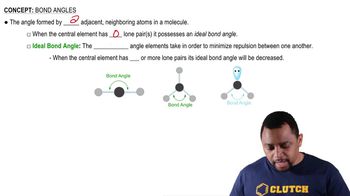
Line-angle formulas, also known as skeletal formulas, are a simplified way of representing organic molecules. In these diagrams, each vertex represents a carbon atom, and lines represent bonds between them. Hydrogen atoms are typically omitted for clarity, as they are assumed to be present to satisfy carbon's tetravalency. Understanding how to read and draw these formulas is essential for visualizing complex organic structures.
Recommended video:
Guided course
01:24
Bond Angles (Simplified) Concept 1

Acid Hydrolysis

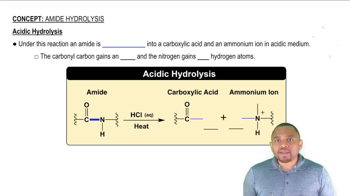
Acid hydrolysis is a chemical reaction where water and an acid are used to break down a compound, typically an ester or a triglyceride, into its constituent parts. In the case of glyceryl trimyristate, this process involves the cleavage of ester bonds, resulting in the formation of glycerol and fatty acids. Recognizing the role of acids and water in this reaction is crucial for writing the balanced equation.
Recommended video:
Guided course
1:12
Acidic Hydrolysis Concept 1

Balanced Chemical Equations

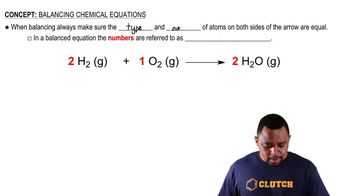
A balanced chemical equation represents a chemical reaction with equal numbers of each type of atom on both sides of the equation. This ensures the law of conservation of mass is upheld, meaning matter is neither created nor destroyed in the reaction. Balancing equations involves adjusting coefficients to achieve this equality, which is vital for accurately depicting the stoichiometry of the reaction.
Recommended video:
Guided course
01:32
Balancing Chemical Equations (Simplified) Concept 1