Use line-angle formulas to write the balanced chemical equation for the acid hydrolysis of glyceryl trimyristate (trimyristin).
Ch.15 Lipids
Timberlake13th EditionChemistry: An Introduction to General, Organic, and Biological ChemistryISBN: 9780134421353Not the one you use?Change textbook
Chapter 15, Problem 41
Draw the condensed structural formula for the cephalin that contains glycerol, two palmitic acids, phosphate, and ethanolamine (ionized).
Verified step by step guidance1
Step 1: Understand the structure of cephalin. Cephalins are a type of phospholipid that consist of a glycerol backbone, two fatty acid chains, a phosphate group, and an ethanolamine group. The ethanolamine group is ionized at physiological pH, meaning it carries a positive charge.
Step 2: Begin with the glycerol backbone. Glycerol is a three-carbon molecule with hydroxyl (-OH) groups attached to each carbon. In cephalins, the hydroxyl groups are replaced by other groups to form ester and phosphodiester bonds.
Step 3: Attach the two palmitic acid chains to the first and second carbons of the glycerol backbone. Palmitic acid is a 16-carbon saturated fatty acid with the formula CH₃(CH₂)₁₄COOH. The carboxyl group (-COOH) of each palmitic acid reacts with the hydroxyl groups on the glycerol to form ester bonds.
Step 4: Attach the phosphate group to the third carbon of the glycerol backbone. The phosphate group replaces the hydroxyl group on the third carbon, forming a phosphoester bond. This phosphate group will serve as the connection point for the ethanolamine group.
Step 5: Attach the ethanolamine group to the phosphate group. Ethanolamine (CH₂CH₂NH₃⁺) forms a phosphodiester bond with the phosphate group. The ionized ethanolamine group carries a positive charge due to the protonated amine group (-NH₃⁺). Combine all these components to draw the condensed structural formula of the cephalin.

Verified video answer for a similar problem:
This video solution was recommended by our tutors as helpful for the problem above.
Video duration:
5mWas this helpful?
Key Concepts
Here are the essential concepts you must grasp in order to answer the question correctly.
Condensed Structural Formula
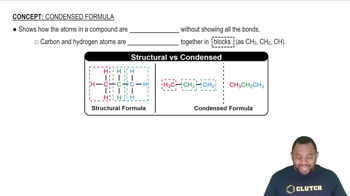
A condensed structural formula is a way of representing a chemical compound that shows the arrangement of atoms and the connectivity between them without depicting all the bonds explicitly. It provides a simplified view of the molecule, allowing chemists to understand its structure quickly. In the case of cephalin, this formula will illustrate how glycerol, fatty acids, phosphate, and ethanolamine are connected.
Recommended video:
Guided course
Condensed Formula Concept 1
Cephalin
Cephalin, also known as phosphatidylethanolamine, is a type of phospholipid found in biological membranes. It consists of a glycerol backbone, two fatty acid chains (in this case, palmitic acids), a phosphate group, and an ethanolamine moiety. Understanding cephalin's structure is crucial for grasping its role in cell membranes and its biochemical functions.
Fatty Acids
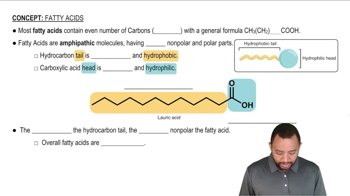
Fatty acids are long hydrocarbon chains with a carboxylic acid group at one end. They are key components of lipids, including phospholipids like cephalin. The specific fatty acids, such as palmitic acid, influence the properties of the lipid, including fluidity and membrane structure, making it essential to identify them when drawing the structural formula.
Recommended video:
Guided course
Fatty Acids Concept 1
Related Practice
Textbook Question
500
views
Textbook Question
Use condensed structural formulas to write the balanced chemical equation for the NaOH saponification of glyceryl trimyristate (trimyristin).
641
views
Textbook Question
Describe the similarities and differences between triacylglycerols and glycerophospholipids.
959
views
Textbook Question
Identify the following glycerophospholipid, which is found in the nerves and spinal cord in the body, as a lecithin or cephalin, and list its components:
855
views
Textbook Question
Identify the following features of this phospholipid, which is abundant in the myelin sheath that surrounds nerve cells:
b. What is the fatty acid?
621
views
Textbook Question
Identify the following features of this phospholipid, which is needed for the brain and nerve tissues:
a. Is the phospholipid formed from glycerol or sphingosine?
805
views