Pearson+ LogoPearson+ Logo
Ch.15 Lipids
Timberlake - Chemistry: An Introduction to General, Organic, and Biological Chemistry 13th Edition
Timberlake13th EditionChemistry: An Introduction to General, Organic, and Biological ChemistryISBN: 9780134421353Not the one you use?Change textbook
Chapter 15, Problem 61

How do molecules of cholesterol affect the structure of cell membranes?

Verified step by step guidance
1
Understand that cholesterol is a type of lipid molecule that is amphipathic, meaning it has both hydrophilic (water-attracting) and hydrophobic (water-repelling) regions.
Recognize that cholesterol molecules are embedded within the phospholipid bilayer of cell membranes, where their hydrophobic regions interact with the fatty acid tails of phospholipids, and their hydrophilic hydroxyl group (-OH) aligns near the polar head groups of the phospholipids.
Learn that cholesterol plays a key role in modulating the fluidity of the cell membrane. It prevents the membrane from becoming too rigid by disrupting the close packing of phospholipid tails, especially at low temperatures.
Understand that cholesterol also prevents the membrane from becoming too fluid by stabilizing the phospholipid bilayer and reducing the movement of phospholipid molecules, particularly at high temperatures.
Conclude that cholesterol contributes to the structural integrity and dynamic nature of the cell membrane, ensuring it remains selectively permeable and functional under varying conditions.

Verified video answer for a similar problem:

This video solution was recommended by our tutors as helpful for the problem above.
Video duration:
3m
Was this helpful?

Key Concepts

Here are the essential concepts you must grasp in order to answer the question correctly.

Cholesterol Structure and Function

Cholesterol is a lipid molecule with a complex ring structure that plays a crucial role in cell membranes. It helps to maintain membrane fluidity by preventing the fatty acid chains of phospholipids from packing too closely together, which is essential for proper membrane function and flexibility.
Recommended video:
Guided course
02:16
Logarithmic Functions

Cell Membrane Composition

Cell membranes are primarily composed of a phospholipid bilayer, which provides a barrier to the passage of ions and molecules. The presence of cholesterol within this bilayer influences its physical properties, such as fluidity and permeability, thereby affecting how cells interact with their environment.
Recommended video:
Guided course
1:00
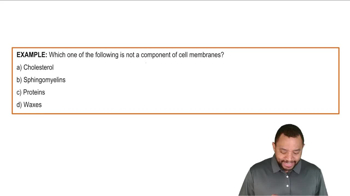
Cell Membranes Example 1

Membrane Fluidity

Membrane fluidity refers to the viscosity of the lipid bilayer of a cell membrane, which is crucial for the movement of proteins and lipids within the membrane. Cholesterol modulates this fluidity, allowing membranes to remain flexible across varying temperatures, which is vital for cellular processes like signaling and transport.
Recommended video:
Guided course
1:00
Cell Membranes Example 1