Pearson+ LogoPearson+ Logo
Ch.15 Lipids
Timberlake - Chemistry: An Introduction to General, Organic, and Biological Chemistry 13th Edition
Timberlake13th EditionChemistry: An Introduction to General, Organic, and Biological ChemistryISBN: 9780134421353Not the one you use?Change textbook
Chapter 15, Problem 11

How does the structure of a fatty acid with a cis double bond differ from the structure of a fatty acid with a trans double bond?

Verified step by step guidance
1
Understand that fatty acids are long hydrocarbon chains with a carboxylic acid group (-COOH) at one end. They can contain double bonds, which affect their structure and properties.
Recognize that a cis double bond in a fatty acid means that the hydrogen atoms attached to the carbon atoms of the double bond are on the same side of the molecule. This creates a bend or kink in the fatty acid chain.
Contrast this with a trans double bond, where the hydrogen atoms attached to the carbon atoms of the double bond are on opposite sides of the molecule. This results in a straighter, more linear structure, similar to saturated fatty acids.
Understand that the kink caused by the cis double bond prevents the fatty acid chains from packing closely together, which affects the melting point and physical state of the fat (e.g., cis fats are often liquid at room temperature).
Note that trans double bonds, due to their straighter structure, allow for tighter packing of fatty acid chains, leading to higher melting points and a solid state at room temperature, which is why trans fats are often used in processed foods.

Verified video answer for a similar problem:

This video solution was recommended by our tutors as helpful for the problem above.
Video duration:
2m
Was this helpful?

Key Concepts

Here are the essential concepts you must grasp in order to answer the question correctly.

Fatty Acid Structure

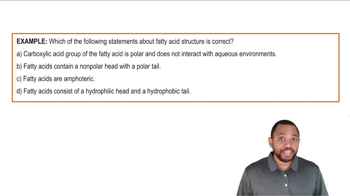
Fatty acids are carboxylic acids with long hydrocarbon chains. Their structure consists of a hydrophilic carboxyl group (-COOH) at one end and a hydrophobic hydrocarbon tail. The length and saturation of the hydrocarbon chain influence the physical properties of the fatty acid, such as melting point and solubility.
Recommended video:
Guided course
0:55
Fatty Acids Example 1

Cis and Trans Double Bonds

Cis and trans refer to the geometric configuration of double bonds in fatty acids. In cis fatty acids, the hydrogen atoms adjacent to the double bond are on the same side, causing a bend in the chain. In contrast, trans fatty acids have hydrogen atoms on opposite sides, resulting in a straighter chain. This structural difference affects the fatty acid's physical properties and biological functions.
Recommended video:
Guided course
3:27
DNA Double Helix Concept 1

Physical Properties and Health Implications

The structural differences between cis and trans fatty acids lead to distinct physical properties. Cis fatty acids tend to be liquid at room temperature and are generally considered healthier, while trans fatty acids are often solid and linked to negative health effects, such as increased risk of heart disease. Understanding these differences is crucial for nutritional science and dietary recommendations.
Recommended video:
Guided course
02:54
Physical Properties Concept