Pearson+ LogoPearson+ Logo
Ch.15 Lipids
Timberlake - Chemistry: An Introduction to General, Organic, and Biological Chemistry 13th Edition
Timberlake13th EditionChemistry: An Introduction to General, Organic, and Biological ChemistryISBN: 9780134421353Not the one you use?Change textbook
Chapter 15, Problem 88b

Match the lipoprotein (1 to 4) with its description (a to d).
1. chylomicrons
2. VLDL
3. LDL
4. HDL
b. “bad” cholesterol

Verified step by step guidance
1
Understand the role of lipoproteins: Lipoproteins are complexes that transport lipids (fats) through the bloodstream. They are classified based on their density and function.
Review the types of lipoproteins: Chylomicrons, VLDL (Very Low-Density Lipoproteins), LDL (Low-Density Lipoproteins), and HDL (High-Density Lipoproteins) each have distinct roles in lipid transport.
Focus on LDL: LDL is often referred to as 'bad cholesterol' because it transports cholesterol to tissues, and excessive levels can lead to plaque buildup in arteries, increasing the risk of cardiovascular diseases.
Match LDL with the description: Since the problem specifies 'bad cholesterol,' the correct match is LDL (Low-Density Lipoproteins).
Verify the match: Ensure that the description aligns with the function of LDL, which is associated with the transport of cholesterol to tissues and its potential negative health effects.

Verified video answer for a similar problem:

This video solution was recommended by our tutors as helpful for the problem above.
Video duration:
4m
Was this helpful?

Key Concepts

Here are the essential concepts you must grasp in order to answer the question correctly.

Lipoproteins

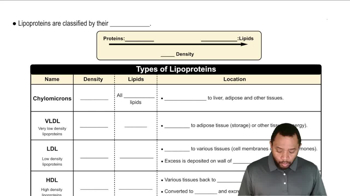
Lipoproteins are complex particles composed of lipids and proteins that transport fats through the bloodstream. They vary in density and composition, influencing their function and role in lipid metabolism. The main types include chylomicrons, VLDL, LDL, and HDL, each serving distinct purposes in the body.
Recommended video:
Guided course
3:52
Lipoproteins for Transport Concept 2

Chylomicrons

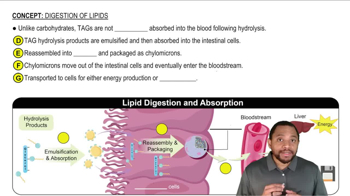
Chylomicrons are the largest type of lipoprotein, primarily responsible for transporting dietary lipids from the intestines to other tissues. They are formed in the intestinal lining after a meal and are rich in triglycerides. Their primary role is to deliver fats to cells for energy or storage.
Recommended video:
Guided course
2:48
Digestion of Lipids Concept 1

LDL and HDL

LDL (Low-Density Lipoprotein) is often referred to as 'bad' cholesterol because high levels can lead to plaque buildup in arteries, increasing the risk of cardiovascular disease. In contrast, HDL (High-Density Lipoprotein) is known as 'good' cholesterol, as it helps remove cholesterol from the bloodstream and transport it to the liver for excretion, thus protecting against heart disease.
Recommended video:
Guided course
3:52
Lipoproteins for Transport Concept 2