Pearson+ LogoPearson+ Logo
Ch.15 Lipids
Timberlake - Chemistry: An Introduction to General, Organic, and Biological Chemistry 13th Edition
Timberlake13th EditionChemistry: An Introduction to General, Organic, and Biological ChemistryISBN: 9780134421353Not the one you use?Change textbook
Chapter 15, Problem 85

Draw the condensed structural formula for a glycerophospholipid that contains glycerol, two stearic acids, phosphate, and ethanolamine (ionized).

Verified step by step guidance
1
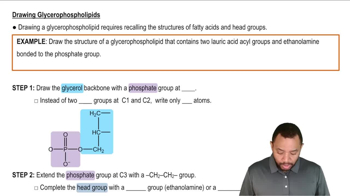
Understand the structure of a glycerophospholipid: A glycerophospholipid consists of a glycerol backbone, two fatty acid chains attached to the first two hydroxyl groups of glycerol, and a phosphate group attached to the third hydroxyl group. The phosphate group is further bonded to an amino alcohol, in this case, ethanolamine (ionized).
Identify the components: Glycerol is a three-carbon molecule with three hydroxyl groups (-OH). Stearic acid is a saturated fatty acid with the formula CH₃(CH₂)₁₆COOH. Phosphate is PO₄³⁻, and ethanolamine (ionized) is H₂NCH₂CH₂OH, where the amino group is protonated to NH₃⁺ in its ionized form.
Attach the two stearic acid molecules to the glycerol backbone: The hydroxyl groups on the first and second carbons of glycerol react with the carboxyl groups of the two stearic acid molecules to form ester bonds. This results in two long hydrocarbon chains attached to the glycerol backbone.
Attach the phosphate group to the third carbon of glycerol: The hydroxyl group on the third carbon of glycerol reacts with the phosphate group to form a phosphoester bond. This creates the hydrophilic head of the glycerophospholipid.
Attach the ethanolamine (ionized) to the phosphate group: The phosphate group forms a bond with the ethanolamine molecule, completing the structure. The final condensed structural formula will show the glycerol backbone, two stearic acid chains, the phosphate group, and the ethanolamine group in their appropriate positions.

Verified video answer for a similar problem:

This video solution was recommended by our tutors as helpful for the problem above.
Video duration:
7m
Was this helpful?

Key Concepts

Here are the essential concepts you must grasp in order to answer the question correctly.

Glycerophospholipid Structure

Glycerophospholipids are a class of lipids that consist of a glycerol backbone, two fatty acid tails, and a phosphate group. The glycerol serves as the central framework, while the fatty acids are esterified to the first and second carbon atoms of glycerol. The phosphate group is attached to the third carbon, which can further bond with various head groups, such as ethanolamine, influencing the molecule's properties and functions in biological membranes.
Recommended video:
Guided course
2:32
Glycerophospholipids Example 3

Fatty Acids

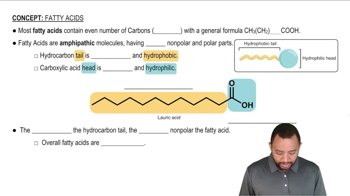
Fatty acids are long hydrocarbon chains with a carboxylic acid group at one end. In this context, stearic acid, a saturated fatty acid with an 18-carbon chain, contributes to the hydrophobic tails of the glycerophospholipid. The saturation of the fatty acids affects the fluidity and stability of the lipid bilayer, which is crucial for membrane integrity and function in biological systems.
Recommended video:
Guided course
2:00
Fatty Acids Concept 1

Ethanolamine Head Group

Ethanolamine is an amino alcohol that can act as a polar head group in glycerophospholipids. When ionized, it carries a positive charge, which enhances its interaction with the negatively charged phosphate group. This ionic interaction plays a significant role in the overall structure and function of the phospholipid, influencing membrane dynamics and the formation of lipid bilayers in cellular environments.
Recommended video:
Guided course
2:26
Alkyl Groups Concept 1