Pearson+ LogoPearson+ Logo
Ch.15 Lipids
Timberlake - Chemistry: An Introduction to General, Organic, and Biological Chemistry 13th Edition
Timberlake13th EditionChemistry: An Introduction to General, Organic, and Biological ChemistryISBN: 9780134421353Not the one you use?Change textbook
Chapter 15, Problem 6

Stearic acid and linoleic acid each have 18 carbon atoms. Why does stearic acid melt at 69 °C but linoleic acid melts at –5 °C?

Verified step by step guidance
1
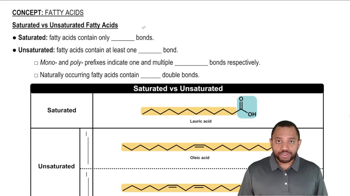
Understand the structure of stearic acid and linoleic acid: Stearic acid is a saturated fatty acid, meaning it has no double bonds between carbon atoms in its hydrocarbon chain. Linoleic acid, on the other hand, is an unsaturated fatty acid with two double bonds in its hydrocarbon chain.
Explain the impact of saturation on molecular packing: Saturated fatty acids like stearic acid have straight chains that can pack closely together in a solid structure, leading to stronger intermolecular forces (van der Waals forces) and a higher melting point.
Discuss the role of double bonds in unsaturated fatty acids: The double bonds in linoleic acid introduce kinks in the hydrocarbon chain, preventing the molecules from packing tightly together. This results in weaker intermolecular forces and a lower melting point.
Relate the melting points to molecular structure: The tight packing of stearic acid molecules due to their straight chains leads to a higher melting point (69 °C), while the kinks in linoleic acid's structure due to double bonds result in a lower melting point (-5 °C).
Summarize the relationship between structure and melting point: The presence or absence of double bonds in fatty acids significantly affects their melting points, with saturated fatty acids having higher melting points due to stronger intermolecular forces and unsaturated fatty acids having lower melting points due to weaker intermolecular forces.

Verified video answer for a similar problem:

This video solution was recommended by our tutors as helpful for the problem above.
Video duration:
3m
Was this helpful?

Key Concepts

Here are the essential concepts you must grasp in order to answer the question correctly.

Saturation of Fatty Acids

Fatty acids can be saturated or unsaturated based on the presence of double bonds between carbon atoms. Stearic acid is a saturated fatty acid, meaning it has no double bonds, allowing its molecules to pack closely together, resulting in a higher melting point. In contrast, linoleic acid is unsaturated, containing two double bonds, which introduce kinks in the molecular structure, preventing tight packing and lowering its melting point.
Recommended video:
Guided course
2:26
Fatty Acids Concept 2

Molecular Structure and Intermolecular Forces

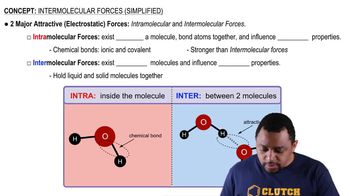
The molecular structure of fatty acids influences their physical properties, including melting points. Stearic acid's straight-chain structure allows for stronger van der Waals forces between molecules, leading to a higher melting point. Linoleic acid's bent structure due to double bonds results in weaker intermolecular forces, contributing to its lower melting point.
Recommended video:
Guided course
01:59
Intermolecular Forces (Simplified) Concept 1

Phase Transition and Temperature

The melting point of a substance is the temperature at which it transitions from solid to liquid. This phase transition is influenced by the arrangement and interactions of molecules. For stearic acid, the strong intermolecular forces require more energy (higher temperature) to overcome, while linoleic acid's weaker forces allow it to melt at a much lower temperature.
Recommended video:
Guided course
01:30
Temperature (Simplified) Concept 1