Pearson+ LogoPearson+ Logo
Ch.16 Amino Acids, Proteins, and Enzymes
Timberlake - Chemistry: An Introduction to General, Organic, and Biological Chemistry 13th Edition
Timberlake13th EditionChemistry: An Introduction to General, Organic, and Biological ChemistryISBN: 9780134421353Not the one you use?Change textbook
Chapter 16, Problem 38b

After the products have formed, what happens to the enzyme?

Verified step by step guidance
1
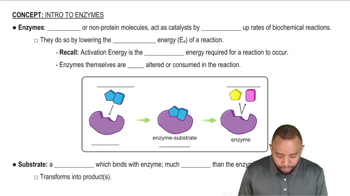
Understand that enzymes are biological catalysts that speed up chemical reactions without being consumed in the process.
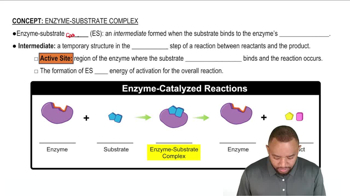
After the products are formed, the enzyme remains unchanged and is released from the enzyme-substrate complex.
The enzyme is now free to bind to another substrate molecule and catalyze another reaction.
This process allows enzymes to be reused multiple times, making them highly efficient in biological systems.
Remember that the enzyme's active site retains its shape and functionality unless it is denatured by factors such as extreme pH or temperature.

Verified video answer for a similar problem:

This video solution was recommended by our tutors as helpful for the problem above.
Video duration:
1m
Was this helpful?

Key Concepts

Here are the essential concepts you must grasp in order to answer the question correctly.

Enzyme Function

Enzymes are biological catalysts that speed up chemical reactions by lowering the activation energy required. They bind to substrates to form an enzyme-substrate complex, facilitating the conversion of substrates into products. Understanding this function is crucial to grasp what happens to the enzyme after the reaction.
Recommended video:
Guided course
02:16
Logarithmic Functions

Enzyme-Product Complex

After the products are formed, the enzyme may briefly form an enzyme-product complex. This complex is a temporary state where the enzyme is still associated with the products before they are released. Recognizing this step is essential for understanding the fate of the enzyme post-reaction.
Recommended video:
Guided course
2:32
Enzyme-Substrate Complex Concept 1

Enzyme Regeneration

Once the products are released, the enzyme is regenerated and can participate in subsequent reactions. This characteristic allows enzymes to be reused multiple times, making them efficient catalysts in biological processes. This regeneration is a key aspect of enzyme functionality and sustainability in metabolic pathways.
Recommended video:
Guided course
2:14
Intro to Enzymes Concept 1