Pearson+ LogoPearson+ Logo
Ch.16 Amino Acids, Proteins, and Enzymes
Timberlake - Chemistry: An Introduction to General, Organic, and Biological Chemistry 13th Edition
Timberlake13th EditionChemistry: An Introduction to General, Organic, and Biological ChemistryISBN: 9780134421353Not the one you use?Change textbook
Chapter 16, Problem 36a

Match the terms (1) active site, (2) lock-and-key model, and (3) induced-fit model with each of the following:
a. the portion of an enzyme where catalytic activity occurs

Verified step by step guidance
1
Understand the term 'active site': The active site is the specific region of an enzyme where substrate molecules bind and undergo a chemical reaction. It is the portion of the enzyme responsible for its catalytic activity.
Understand the 'lock-and-key model': This model suggests that the enzyme's active site has a specific shape that exactly matches the shape of its substrate, similar to how a key fits into a specific lock.
Understand the 'induced-fit model': This model proposes that the enzyme's active site is flexible and can adjust its shape to better fit the substrate when it binds, enhancing the enzyme's ability to catalyze the reaction.
Match the term 'active site' with the description 'the portion of an enzyme where catalytic activity occurs,' as this is the region directly involved in the chemical reaction.
Review the lock-and-key and induced-fit models to understand how they describe the interaction between the active site and the substrate, but note that neither of these models directly defines the active site itself.

Verified video answer for a similar problem:

This video solution was recommended by our tutors as helpful for the problem above.
Video duration:
49s
Was this helpful?

Key Concepts

Here are the essential concepts you must grasp in order to answer the question correctly.

Active Site

The active site is a specific region on an enzyme where substrate molecules bind and undergo a chemical reaction. This site is typically a pocket or groove on the enzyme's surface, shaped to fit the substrate, allowing for the catalytic activity that transforms the substrate into products.
Recommended video:
Guided course
1:06
Factors Affecting Enzyme Activity Concept 1

Lock-and-Key Model

The lock-and-key model is a theory that describes how enzymes and substrates interact. According to this model, the enzyme's active site (the 'lock') is precisely shaped to fit a specific substrate (the 'key'), ensuring that only the correct substrate can bind and be catalyzed by the enzyme.
Recommended video:
Guided course
1:26
Models of Enzyme Action Example 1

Induced-Fit Model

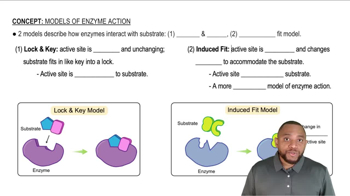
The induced-fit model expands on the lock-and-key concept by suggesting that the binding of a substrate induces a conformational change in the enzyme. This change enhances the fit between the enzyme and substrate, allowing for a more effective catalytic process, as the enzyme adjusts its shape to better accommodate the substrate.
Recommended video:
Guided course
2:39
Models of Enzyme Action Concept 1