Pearson+ LogoPearson+ Logo
Ch.16 Amino Acids, Proteins, and Enzymes
Timberlake - Chemistry: An Introduction to General, Organic, and Biological Chemistry 13th Edition
Timberlake13th EditionChemistry: An Introduction to General, Organic, and Biological ChemistryISBN: 9780134421353Not the one you use?Change textbook
Chapter 16, Problem 62b

Would you expect to find this segment at the center or at the surface of a protein? Why?

Verified step by step guidance
1
Step 1: Identify the segment in question. Determine whether the segment contains hydrophobic (nonpolar) or hydrophilic (polar or charged) amino acid residues. Hydrophobic residues tend to avoid water, while hydrophilic residues interact favorably with water.
Step 2: Recall the structure of a protein. Proteins fold in such a way that hydrophobic residues are typically buried in the interior (center) of the protein, away from the aqueous environment, while hydrophilic residues are usually exposed on the surface, interacting with water.
Step 3: Analyze the chemical properties of the segment. If the segment contains mostly hydrophobic residues, it is likely to be found in the center of the protein. If it contains mostly hydrophilic residues, it is likely to be found on the surface.
Step 4: Consider the role of the protein's environment. If the protein is in an aqueous (water-based) environment, the hydrophobic effect will drive hydrophobic residues inward. If the protein is in a nonpolar environment, the arrangement might differ.
Step 5: Conclude the reasoning based on the segment's properties and the protein's environment. This will help determine whether the segment is more likely to be at the center or the surface of the protein.

Verified video answer for a similar problem:

This video solution was recommended by our tutors as helpful for the problem above.
Video duration:
5m
Was this helpful?

Key Concepts

Here are the essential concepts you must grasp in order to answer the question correctly.

Protein Structure

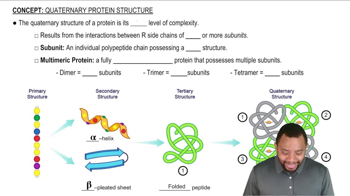
Proteins are composed of amino acids and have four levels of structure: primary, secondary, tertiary, and quaternary. The arrangement of these structures determines the protein's function and stability. Understanding where segments of a protein are located—whether at the center or surface—relates to their interactions and roles within the protein's overall architecture.
Recommended video:
Guided course
3:26
Quaternary Protein Structure Concept 1

Hydrophobic and Hydrophilic Interactions

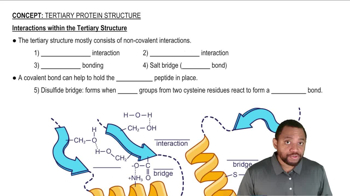
Amino acids can be classified as hydrophobic (water-repelling) or hydrophilic (water-attracting). Hydrophobic segments tend to be found in the interior of proteins, away from water, while hydrophilic segments are often located on the surface, interacting with the aqueous environment. This distribution is crucial for protein folding and function.
Recommended video:
Guided course
2:41
Interactions within the Tertiary Structure Concept 2

Protein Folding

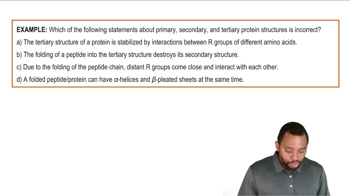
Protein folding is the process by which a protein assumes its functional three-dimensional shape. This process is driven by various interactions, including hydrogen bonds, ionic bonds, and van der Waals forces. The location of specific segments within the protein—whether at the center or surface—affects how the protein interacts with other molecules and performs its biological functions.
Recommended video:
Guided course
1:17
Tertiary Protein Structure Example 1