Pearson+ LogoPearson+ Logo
Ch.16 Amino Acids, Proteins, and Enzymes
Timberlake - Chemistry: An Introduction to General, Organic, and Biological Chemistry 13th Edition
Timberlake13th EditionChemistry: An Introduction to General, Organic, and Biological ChemistryISBN: 9780134421353Not the one you use?Change textbook
Chapter 16, Problem 61a

Draw the condensed structural formula for Ser–Lys–Asp.

Verified step by step guidance
1
Step 1: Understand the problem. You are tasked with drawing the condensed structural formula for a tripeptide composed of three amino acids: Serine (Ser), Lysine (Lys), and Aspartic acid (Asp). A tripeptide is formed by linking these amino acids through peptide bonds.
Step 2: Recall the general structure of an amino acid. Each amino acid has a central carbon atom (α-carbon) bonded to an amino group (-NH₂), a carboxyl group (-COOH), a hydrogen atom, and a unique side chain (R-group). For Serine, the R-group is -CH₂OH; for Lysine, the R-group is -(CH₂)₄NH₂; and for Aspartic acid, the R-group is -CH₂COOH.
Step 3: Understand peptide bond formation. A peptide bond is formed between the carboxyl group of one amino acid and the amino group of the next amino acid, releasing a molecule of water (H₂O). This process links the amino acids in the order Ser–Lys–Asp.
Step 4: Write the condensed structural formula. Start with the amino group of Serine, followed by its α-carbon and side chain. Then, connect it to Lysine via a peptide bond, showing its α-carbon and side chain. Finally, connect Lysine to Aspartic acid via another peptide bond, showing its α-carbon and side chain. Ensure the terminal carboxyl group of Aspartic acid is included.
Step 5: Double-check the structure. Verify that all peptide bonds are correctly formed, the side chains are accurately represented, and the terminal amino group (on Serine) and carboxyl group (on Aspartic acid) are present in the structure.

Verified video answer for a similar problem:

This video solution was recommended by our tutors as helpful for the problem above.
Video duration:
6m
Was this helpful?

Key Concepts

Here are the essential concepts you must grasp in order to answer the question correctly.

Condensed Structural Formula

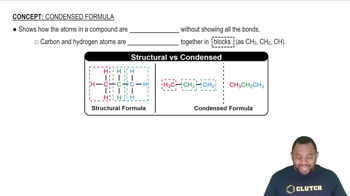
A condensed structural formula is a way of representing a chemical compound that shows the arrangement of atoms and the connectivity between them without depicting all the bonds explicitly. It simplifies the structure by grouping atoms together, often using parentheses to indicate branching. This format is particularly useful for larger molecules, as it provides a clearer view of the molecular structure while maintaining essential information about the composition.
Recommended video:
Guided course
1:53
Condensed Formula Concept 1

Amino Acids

Amino acids are organic compounds that serve as the building blocks of proteins. Each amino acid consists of a central carbon atom bonded to an amino group, a carboxyl group, a hydrogen atom, and a variable side chain (R group) that determines its unique properties. In the context of the question, Serine (Ser), Lysine (Lys), and Aspartic acid (Asp) are specific amino acids that contribute to the overall structure and function of proteins.
Recommended video:
Guided course
3:03
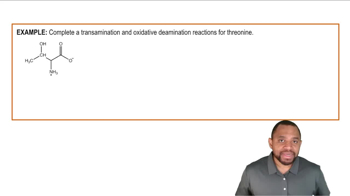
Amino Acid Catabolism: Amino Group Example 2

Peptide Bond

A peptide bond is a covalent bond that links two amino acids together, forming a dipeptide or a longer polypeptide chain. This bond is formed through a dehydration synthesis reaction, where the carboxyl group of one amino acid reacts with the amino group of another, releasing a molecule of water. Understanding peptide bonds is crucial for drawing the condensed structural formula of a peptide like Ser–Lys–Asp, as it illustrates how these amino acids are connected in a sequence.
Recommended video:
Guided course
1:24
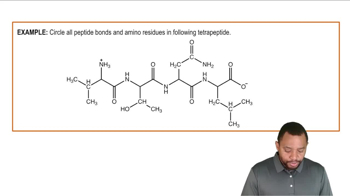
Peptides Example 1