Pearson+ LogoPearson+ Logo
Ch.16 Amino Acids, Proteins, and Enzymes
Timberlake - Chemistry: An Introduction to General, Organic, and Biological Chemistry 13th Edition
Timberlake13th EditionChemistry: An Introduction to General, Organic, and Biological ChemistryISBN: 9780134421353Not the one you use?Change textbook
Chapter 16, Problem 63b

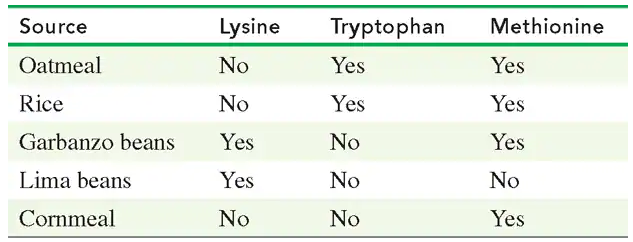
Seeds and vegetables are often deficient in one or more essential amino acids. Using the following table, state whether each combination provides all of the essential amino acids:

b. lima beans and cornmeal

Verified step by step guidance
1
Identify the essential amino acids that are typically deficient in lima beans and cornmeal. Essential amino acids are those that the body cannot synthesize and must be obtained from the diet.
Consult the provided table (or data) to determine which essential amino acids are present in lima beans and which are present in cornmeal.
Compare the amino acid profiles of lima beans and cornmeal to check if the combination of the two foods provides all the essential amino acids. This is based on the principle of complementary proteins, where two incomplete protein sources together provide a complete amino acid profile.
If any essential amino acid is missing in both lima beans and cornmeal, the combination does not provide all essential amino acids. If all essential amino acids are covered between the two, the combination is complete.
Conclude whether the combination of lima beans and cornmeal provides all essential amino acids based on the analysis of their amino acid profiles.

Verified video answer for a similar problem:

This video solution was recommended by our tutors as helpful for the problem above.
Video duration:
3m
Was this helpful?

Key Concepts

Here are the essential concepts you must grasp in order to answer the question correctly.

Essential Amino Acids

Essential amino acids are the amino acids that the human body cannot synthesize and must be obtained through diet. There are nine essential amino acids, including lysine, methionine, and tryptophan, which are crucial for protein synthesis, tissue repair, and nutrient absorption. Understanding which foods contain these amino acids is vital for assessing dietary adequacy.
Recommended video:
Guided course
3:03
Amino Acid Catabolism: Amino Group Example 2

Complementary Proteins

Complementary proteins refer to two or more protein sources that, when combined, provide all the essential amino acids that one source may lack. For example, legumes like lima beans are low in methionine but high in lysine, while grains like cornmeal are low in lysine but high in methionine. Combining these foods can create a complete protein profile.
Recommended video:
Guided course
2:01
Digestion of Proteins Concept 1

Protein Quality

Protein quality is a measure of how well a protein source meets the body's amino acid requirements. It is often assessed using the Protein Digestibility-Corrected Amino Acid Score (PDCAAS), which evaluates both the amino acid profile and digestibility. Foods with high protein quality provide all essential amino acids in sufficient quantities, making them more beneficial for health.
Recommended video:
Guided course
2:01
Digestion of Proteins Concept 1