Classify each of the amino acids in problem 16.5 as polar or nonpolar. If polar, indicate if the R group is neutral, acidic, or basic. Indicate if each is hydrophobic or hydrophilic.
Ch.16 Amino Acids, Proteins, and Enzymes
Timberlake13th EditionChemistry: An Introduction to General, Organic, and Biological ChemistryISBN: 9780134421353Not the one you use?Change textbook
Chapter 16, Problem 11a
Draw the condensed structural formula for each of the following peptides, and give its three-letter and one-letter abbreviations:
a. alanylcysteine
Verified step by step guidance1
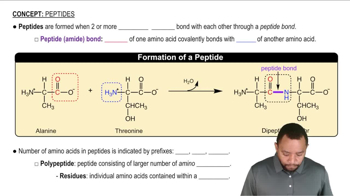
Step 1: Understand the problem. The task is to draw the condensed structural formula for the dipeptide alanylcysteine, which is formed by linking the amino acids alanine and cysteine. Additionally, provide the three-letter and one-letter abbreviations for this peptide.
Step 2: Recall the structure of alanine. Alanine (Ala) is a nonpolar amino acid with the side chain -CH₃. Its general structure is NH₂-CH(CH₃)-COOH.
Step 3: Recall the structure of cysteine. Cysteine (Cys) is a polar amino acid with a thiol (-SH) group in its side chain. Its general structure is NH₂-CH(CH₂SH)-COOH.
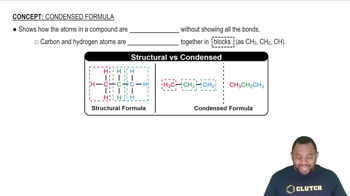
Step 4: Form the peptide bond. A peptide bond is formed between the carboxyl group (-COOH) of alanine and the amino group (-NH₂) of cysteine. This involves the removal of a water molecule (H₂O) during the condensation reaction. The resulting structure will have the following condensed formula: NH₂-CH(CH₃)-CO-NH-CH(CH₂SH)-COOH.
Step 5: Provide the abbreviations. The three-letter abbreviation for alanylcysteine is Ala-Cys, and the one-letter abbreviation is AC.

Verified video answer for a similar problem:
This video solution was recommended by our tutors as helpful for the problem above.
Video duration:
2mWas this helpful?
Key Concepts
Here are the essential concepts you must grasp in order to answer the question correctly.
Peptide Structure
Peptides are short chains of amino acids linked by peptide bonds. The structure of a peptide is determined by the sequence of its constituent amino acids, which influences its properties and functions. Understanding how to represent peptides structurally, including their condensed formulas, is essential for biochemistry and molecular biology.
Recommended video:
Guided course
Peptides Concept 1
Amino Acid Abbreviations
Amino acids are the building blocks of peptides and proteins, each having a unique three-letter and one-letter abbreviation. For example, alanine is abbreviated as 'Ala' (three-letter) and 'A' (one-letter), while cysteine is 'Cys' and 'C'. Familiarity with these abbreviations is crucial for efficiently communicating and interpreting peptide sequences.
Recommended video:
Guided course
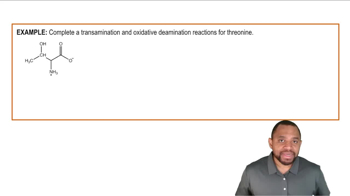
Amino Acid Catabolism: Amino Group Example 2
Condensed Structural Formula
A condensed structural formula provides a simplified representation of a molecule, showing the arrangement of atoms without depicting all bonds explicitly. In the context of peptides, it illustrates how amino acids are connected, allowing for a quick understanding of the molecule's structure. Mastery of this notation is important for visualizing and analyzing chemical compounds.
Recommended video:
Guided course
Condensed Formula Concept 1
Related Practice
Textbook Question
682
views
Textbook Question
Give the name for the amino acid represented by each of the following abbreviations:
d. Cys
652
views
Textbook Question
Give the name for the amino acid represented by each of the following abbreviations:
d. G
638
views
Textbook Question
Draw the condensed structural formula for each of the following peptides, and give its three-letter and one-letter abbreviations:
c. glycylalanylvaline
951
views
Textbook Question
Draw the condensed structural formula for each of the following peptides, and give its three-letter and one-letter abbreviations:
b. threonylleucine
740
views

Textbook Question
Draw the condensed structural formula for each of the following peptides, and give its three-letter and one-letter abbreviations:
d. histidylglycylglutamylisoleucine
43
views