Pearson+ LogoPearson+ Logo
Ch.16 Amino Acids, Proteins, and Enzymes
Timberlake - Chemistry: An Introduction to General, Organic, and Biological Chemistry 13th Edition
Timberlake13th EditionChemistry: An Introduction to General, Organic, and Biological ChemistryISBN: 9780134421353Not the one you use?Change textbook
Chapter 16, Problem 72b

Maltase is an enzyme that hydrolyzes maltose to two glucose molecules.
b. Draw an energy diagram for the reaction with and without maltase.

Verified step by step guidance
1
Understand the reaction: Maltase is an enzyme that catalyzes the hydrolysis of maltose into two glucose molecules. Enzymes lower the activation energy of a reaction, making it proceed faster. This will be reflected in the energy diagram.
Draw the x-axis and y-axis of the energy diagram: The x-axis represents the reaction progress (from reactants to products), and the y-axis represents the energy of the system.
Plot the energy curve for the reaction without maltase: Start with the energy of the reactants (maltose and water). Draw a high peak to represent the activation energy required for the reaction to proceed without the enzyme. Then, show the energy decreasing to the level of the products (two glucose molecules).
Plot the energy curve for the reaction with maltase: Start at the same energy level for the reactants. Draw a lower peak to represent the reduced activation energy due to the presence of maltase. The final energy level of the products remains the same as in the previous curve, as enzymes do not change the overall energy of the reaction.
Label the diagram: Clearly label the reactants, products, activation energy (with and without maltase), and the transition state. Indicate the lower activation energy in the presence of maltase to highlight the enzyme's effect.

Verified video answer for a similar problem:

This video solution was recommended by our tutors as helpful for the problem above.
Video duration:
8m
Was this helpful?

Key Concepts

Here are the essential concepts you must grasp in order to answer the question correctly.

Enzymes and Catalysis

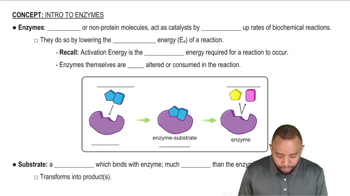
Enzymes are biological catalysts that speed up chemical reactions by lowering the activation energy required for the reaction to occur. Maltase, specifically, catalyzes the hydrolysis of maltose into glucose, facilitating this process in biological systems. Understanding how enzymes function is crucial for analyzing their impact on reaction energy profiles.
Recommended video:
Guided course
2:14
Intro to Enzymes Concept 1

Activation Energy

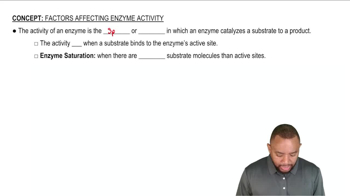
Activation energy is the minimum energy required for a chemical reaction to proceed. In the context of maltase, the enzyme reduces the activation energy needed for the hydrolysis of maltose, allowing the reaction to occur more readily. This concept is essential for understanding the differences in energy diagrams with and without the enzyme.
Recommended video:
Guided course
1:06
Factors Affecting Enzyme Activity Concept 1

Energy Diagrams

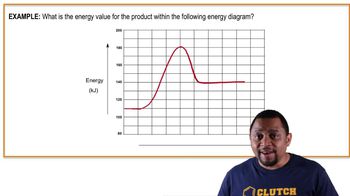
Energy diagrams visually represent the energy changes during a chemical reaction, illustrating the energy of reactants, products, and the activation energy barrier. When drawing energy diagrams for reactions with and without maltase, one can observe how the presence of the enzyme lowers the activation energy, resulting in a more favorable energy profile for the reaction.
Recommended video:
Guided course
00:37
Energy Diagrams Example 1