Pearson+ LogoPearson+ Logo
Ch.16 Amino Acids, Proteins, and Enzymes
Timberlake - Chemistry: An Introduction to General, Organic, and Biological Chemistry 13th Edition
Timberlake13th EditionChemistry: An Introduction to General, Organic, and Biological ChemistryISBN: 9780134421353Not the one you use?Change textbook
Chapter 16, Problem 76a

Give the substrate of each of the following enzymes:
a. maltase

Verified step by step guidance
1
Understand the role of enzymes: Enzymes are biological catalysts that speed up chemical reactions by binding to specific molecules called substrates. The name of an enzyme often gives a clue about its substrate or the reaction it catalyzes.
Analyze the enzyme name 'maltase': The suffix '-ase' indicates that this is an enzyme, and the root 'malt-' suggests a connection to maltose, a type of sugar.
Recall the function of maltase: Maltase is an enzyme that catalyzes the hydrolysis of maltose into two glucose molecules. Hydrolysis is a reaction where water is used to break a bond.
Identify the substrate: Based on the enzyme's name and function, the substrate of maltase is maltose, a disaccharide composed of two glucose units linked by a glycosidic bond.
Conclude: The substrate of maltase is maltose, and the enzyme facilitates its breakdown into glucose molecules during digestion.

Verified video answer for a similar problem:

This video solution was recommended by our tutors as helpful for the problem above.
Video duration:
41s
Was this helpful?

Key Concepts

Here are the essential concepts you must grasp in order to answer the question correctly.

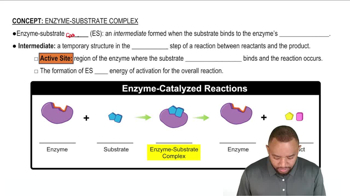
Enzyme Substrate Specificity

Enzyme substrate specificity refers to the unique ability of an enzyme to bind to a specific substrate, which is the molecule upon which the enzyme acts. This specificity is determined by the enzyme's active site, where the substrate fits like a key in a lock. Understanding this concept is crucial for identifying the correct substrate for any given enzyme.
Recommended video:
Guided course
2:32
Enzyme-Substrate Complex Concept 1

Maltase Function

Maltase is an enzyme that catalyzes the hydrolysis of maltose, a disaccharide sugar, into two glucose molecules. This reaction is essential in carbohydrate digestion, particularly in breaking down starches into simpler sugars that can be absorbed by the body. Recognizing maltase's function helps in understanding its substrate and role in metabolic processes.
Recommended video:
Guided course
02:16
Logarithmic Functions

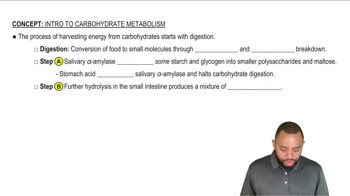
Carbohydrate Metabolism

Carbohydrate metabolism encompasses the biochemical processes that convert carbohydrates into energy and other metabolites. This includes the breakdown of complex carbohydrates into simple sugars, which are then utilized for energy production. Knowledge of carbohydrate metabolism is important for comprehending how enzymes like maltase contribute to overall energy homeostasis in living organisms.
Recommended video:
Guided course
1:53
Intro To Carbohydrate Metabolism Concept 1