Pearson+ LogoPearson+ Logo
Ch.16 Amino Acids, Proteins, and Enzymes
Timberlake - Chemistry: An Introduction to General, Organic, and Biological Chemistry 13th Edition
Timberlake13th EditionChemistry: An Introduction to General, Organic, and Biological ChemistryISBN: 9780134421353Not the one you use?Change textbook
Chapter 16, Problem 70

Why do enzymes function only under mild conditions?

Verified step by step guidance
1
Enzymes are biological catalysts made of proteins that speed up chemical reactions in living organisms. They are highly sensitive to their environment because their structure determines their function.
Enzymes function under mild conditions (e.g., physiological temperature, pH, and pressure) because their three-dimensional structure, or conformation, is stabilized by weak interactions such as hydrogen bonds, ionic bonds, and hydrophobic interactions.
Extreme conditions, such as high temperatures or extreme pH levels, can disrupt these weak interactions, leading to denaturation. Denaturation is the process where the enzyme loses its specific shape, and as a result, its active site is no longer functional.
The mild conditions in which enzymes operate are optimal for maintaining their structure and ensuring that the substrate can bind to the active site effectively, allowing the enzyme to catalyze the reaction efficiently.
In summary, enzymes function only under mild conditions because their delicate structure is essential for their activity, and harsh conditions can irreversibly damage their ability to catalyze reactions.

Verified video answer for a similar problem:

This video solution was recommended by our tutors as helpful for the problem above.
Video duration:
4m
Was this helpful?

Key Concepts

Here are the essential concepts you must grasp in order to answer the question correctly.

Enzyme Structure and Function

Enzymes are biological catalysts that speed up chemical reactions by lowering the activation energy required. Their specific three-dimensional structure, which includes an active site, is crucial for binding substrates and facilitating reactions. This structure is sensitive to environmental conditions, which can affect enzyme activity.
Recommended video:
Guided course
02:16
Logarithmic Functions

Optimal Conditions for Enzyme Activity

Enzymes typically function best under mild conditions, such as moderate temperatures and neutral pH levels. Extreme conditions can lead to denaturation, where the enzyme's structure is altered, resulting in loss of function. Understanding these optimal conditions is essential for maintaining enzyme activity in biological systems.
Recommended video:
Guided course
5:33
Factors Affecting Enzyme Activity Concept 2

Biological Relevance of Mild Conditions

Mild conditions are biologically relevant because they align with the physiological environments of living organisms. Enzymes evolved to operate efficiently within these parameters, ensuring that metabolic processes occur without causing damage to cells. This adaptation is vital for sustaining life and maintaining homeostasis.
Recommended video:
Guided course
2:21
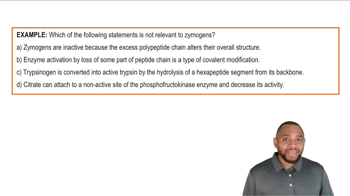
Zymogens Example 1