Pearson+ LogoPearson+ Logo
Ch.16 Amino Acids, Proteins, and Enzymes
Timberlake - Chemistry: An Introduction to General, Organic, and Biological Chemistry 13th Edition
Timberlake13th EditionChemistry: An Introduction to General, Organic, and Biological ChemistryISBN: 9780134421353Not the one you use?Change textbook
Chapter 16, Problem 65c

What are some differences between each of the following pairs?
c. polar and nonpolar amino acids

Verified step by step guidance
1
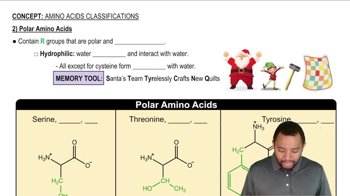
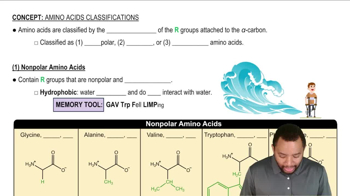
Understand the concept of polarity in amino acids: Polarity in amino acids is determined by the nature of their side chains (R groups). Polar amino acids have side chains that can form hydrogen bonds or interact with water, while nonpolar amino acids have hydrophobic side chains that do not interact well with water.
Identify the characteristics of polar amino acids: Polar amino acids typically contain functional groups such as hydroxyl (-OH), amide (-CONH2), or charged groups (e.g., -COO⁻ or -NH3⁺) in their side chains, making them hydrophilic and soluble in water.
Identify the characteristics of nonpolar amino acids: Nonpolar amino acids have side chains that are primarily composed of hydrocarbons (e.g., alkyl or aromatic groups), making them hydrophobic and less soluble in water.
Explain the behavior in aqueous environments: Polar amino acids tend to be found on the exterior of proteins, interacting with the aqueous environment, while nonpolar amino acids are often located in the interior of proteins, away from water, to stabilize the protein structure.
Summarize the key difference: The primary difference between polar and nonpolar amino acids lies in the nature of their side chains—polar amino acids are hydrophilic and interact with water, while nonpolar amino acids are hydrophobic and avoid water.

Verified video answer for a similar problem:

This video solution was recommended by our tutors as helpful for the problem above.
Video duration:
1m
Was this helpful?

Key Concepts

Here are the essential concepts you must grasp in order to answer the question correctly.

Polar Amino Acids

Polar amino acids have side chains that are hydrophilic, meaning they can interact favorably with water and other polar substances. These amino acids typically contain functional groups such as hydroxyl (-OH), carboxyl (-COOH), or amine (-NH2) groups, which can form hydrogen bonds. Examples include serine, threonine, and asparagine, which play crucial roles in protein structure and function due to their ability to form interactions with the aqueous environment.
Recommended video:
Guided course
2:55
Polar Amino Acids Concept 2

Nonpolar Amino Acids

Nonpolar amino acids possess side chains that are hydrophobic, making them less likely to interact with water. These amino acids usually contain hydrocarbon chains or aromatic rings, which do not form hydrogen bonds with water. Examples include alanine, valine, and phenylalanine. Their hydrophobic nature often leads them to be found in the interior of proteins, contributing to the overall stability and folding of the protein structure.
Recommended video:
Guided course
5:16
Nonpolar Amino Acids Concept 1

Hydrophobic Effect

The hydrophobic effect is a key principle in biochemistry that describes how nonpolar substances tend to aggregate in aqueous solutions to minimize their exposure to water. This phenomenon is crucial for protein folding, as nonpolar amino acids cluster together in the protein's core, while polar amino acids remain on the surface. Understanding this effect helps explain the structural organization of proteins and the behavior of amino acids in biological systems.
Recommended video:
Guided course
04:38
Solubility: Temperature Effect Concept 1