Pearson+ LogoPearson+ Logo
Ch.16 Amino Acids, Proteins, and Enzymes
Timberlake - Chemistry: An Introduction to General, Organic, and Biological Chemistry 13th Edition
Timberlake13th EditionChemistry: An Introduction to General, Organic, and Biological ChemistryISBN: 9780134421353Not the one you use?Change textbook
Chapter 16, Problem 66b

What are some differences between each of the following pairs?
b. an ⍺ helix and collagen

Verified step by step guidance
1
Understand the context: Both α helix and collagen are structural components of proteins, but they differ in their structure and function. The α helix is a common secondary structure in proteins, while collagen is a fibrous protein with a unique triple-helix structure.
Step 1: Describe the α helix. The α helix is a right-handed helical structure stabilized by hydrogen bonds between the carbonyl oxygen of one amino acid and the amide hydrogen of another amino acid four residues away. This structure is compact and found in globular proteins.
Step 2: Describe collagen. Collagen is a fibrous protein that forms a triple helix, consisting of three polypeptide chains wound around each other. It is rich in glycine, proline, and hydroxyproline, which contribute to its strength and stability. Collagen is a major component of connective tissues like tendons, ligaments, and skin.
Step 3: Highlight the differences in structure. The α helix is a single polypeptide chain with intrachain hydrogen bonding, while collagen consists of three polypeptide chains with interchain hydrogen bonding. Additionally, the α helix is more flexible, whereas collagen is rigid and provides tensile strength.
Step 4: Highlight the differences in function. The α helix is typically found in globular proteins and contributes to their dynamic roles, such as enzyme activity or transport. Collagen, on the other hand, is a structural protein that provides support and strength to tissues.

Verified video answer for a similar problem:

This video solution was recommended by our tutors as helpful for the problem above.
Video duration:
2m
Was this helpful?

Key Concepts

Here are the essential concepts you must grasp in order to answer the question correctly.

α Helix Structure

The α helix is a common structural motif in proteins, characterized by a right-handed coil where each turn of the helix contains about 3.6 amino acids. This structure is stabilized by hydrogen bonds between the backbone amide and carbonyl groups, contributing to the overall stability and functionality of proteins. The α helix is crucial for the secondary structure of proteins and plays a significant role in their biological activity.
Recommended video:
Guided course
3:27
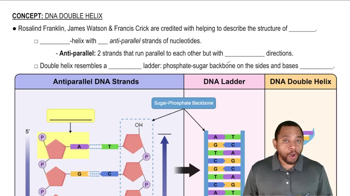
DNA Double Helix Concept 1

Collagen Structure

Collagen is a fibrous protein that forms a triple helix structure, consisting of three polypeptide chains wound around each other. This unique structure provides tensile strength and is a major component of connective tissues, such as skin, tendons, and cartilage. Unlike the α helix, collagen's stability is enhanced by cross-linking between the chains, making it essential for structural integrity in various biological tissues.
Recommended video:
Guided course
1:01
Structural Formula Concept 2

Functional Differences

The functional differences between an α helix and collagen arise from their distinct structures. The α helix is often involved in the active sites of enzymes and plays a role in protein interactions, while collagen primarily provides structural support and strength to tissues. These differences in function are a direct result of their unique structural properties, influencing how they contribute to the overall physiology of organisms.
Recommended video:
Guided course
02:16
Logarithmic Functions