Pearson+ LogoPearson+ Logo
Ch.17 Nucleic Acids and Protein Synthesis
Timberlake - Chemistry: An Introduction to General, Organic, and Biological Chemistry 13th Edition
Timberlake13th EditionChemistry: An Introduction to General, Organic, and Biological ChemistryISBN: 9780134421353Not the one you use?Change textbook
Chapter 17, Problem 7b

Identify each of the following as a nucleoside or a nucleotide:
b. deoxycytidine

Verified step by step guidance
1
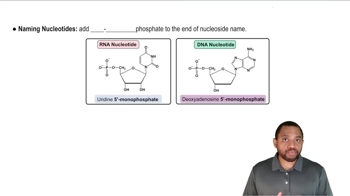
Step 1: Understand the difference between a nucleoside and a nucleotide. A nucleoside consists of a nitrogenous base (a purine or pyrimidine) attached to a sugar (ribose or deoxyribose) but does not include a phosphate group. A nucleotide, on the other hand, includes a nitrogenous base, a sugar, and one or more phosphate groups.
Step 2: Analyze the given name, 'deoxycytidine.' The prefix 'deoxy-' indicates that the sugar is deoxyribose, which is a sugar missing an oxygen atom compared to ribose. The base 'cytidine' refers to the nitrogenous base cytosine attached to a sugar.
Step 3: Check if the name includes any mention of a phosphate group. In this case, 'deoxycytidine' does not mention a phosphate group, which is a key component of a nucleotide.
Step 4: Conclude that since 'deoxycytidine' consists of a nitrogenous base (cytosine) and a sugar (deoxyribose) but lacks a phosphate group, it is classified as a nucleoside.
Step 5: To reinforce your understanding, remember that if a phosphate group were present, the name would include terms like 'monophosphate,' 'diphosphate,' or 'triphosphate,' indicating a nucleotide.

Verified video answer for a similar problem:

This video solution was recommended by our tutors as helpful for the problem above.
Video duration:
1m
Was this helpful?

Key Concepts

Here are the essential concepts you must grasp in order to answer the question correctly.

Nucleoside

A nucleoside is a molecular structure consisting of a nitrogenous base (adenine, guanine, cytosine, or thymine) attached to a sugar molecule (ribose or deoxyribose). Nucleosides do not contain phosphate groups, distinguishing them from nucleotides. They play a crucial role in the formation of nucleotides and are fundamental components of nucleic acids.
Recommended video:
Guided course
1:21
Naming Nucleosides and Nucleotides Concept 2

Nucleotide

A nucleotide is a building block of nucleic acids, composed of three components: a nitrogenous base, a sugar (ribose or deoxyribose), and one or more phosphate groups. Nucleotides are essential for various biological functions, including energy transfer (as ATP) and serving as the monomers for DNA and RNA synthesis. The presence of phosphate groups is what differentiates nucleotides from nucleosides.
Recommended video:
Guided course
1:21
Naming Nucleosides and Nucleotides Concept 2

Deoxycytidine

Deoxycytidine is a specific type of nucleoside that consists of the nitrogenous base cytosine attached to a deoxyribose sugar. It is a key component of DNA, where it pairs with guanine. Understanding its structure helps in distinguishing it from nucleotides, which would include phosphate groups, making deoxycytidine a nucleoside rather than a nucleotide.