Pearson+ LogoPearson+ Logo
Ch.17 Nucleic Acids and Protein Synthesis
Timberlake - Chemistry: An Introduction to General, Organic, and Biological Chemistry 13th Edition
Timberlake13th EditionChemistry: An Introduction to General, Organic, and Biological ChemistryISBN: 9780134421353Not the one you use?Change textbook
Chapter 17, Problem 2a

Identify each of the following bases as a purine or a pyrimidine:
a. guanine

Verified step by step guidance
1
Step 1: Understand the difference between purines and pyrimidines. Purines are nitrogenous bases with a double-ring structure, while pyrimidines have a single-ring structure.
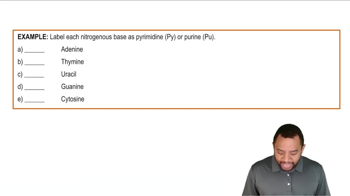
Step 2: Recall the common purines and pyrimidines. The purines are adenine (A) and guanine (G), while the pyrimidines are cytosine (C), thymine (T), and uracil (U).
Step 3: Analyze the given base, guanine. Guanine is one of the nitrogenous bases found in DNA and RNA.
Step 4: Determine the structure of guanine. Guanine has a double-ring structure, which is characteristic of purines.
Step 5: Conclude that guanine is a purine based on its double-ring structure and its classification as one of the two purines in nucleic acids.

Verified video answer for a similar problem:

This video solution was recommended by our tutors as helpful for the problem above.
Video duration:
33s
Was this helpful?

Key Concepts

Here are the essential concepts you must grasp in order to answer the question correctly.

Purines

Purines are one of the two classes of nitrogenous bases found in nucleic acids, characterized by a double-ring structure. The two primary purines in DNA and RNA are adenine (A) and guanine (G). Their structure allows them to form hydrogen bonds with complementary pyrimidines, playing a crucial role in the formation of the DNA double helix and RNA structures.
Recommended video:
Guided course
1:09
Nitrogenous Bases Example 1

Pyrimidines

Pyrimidines are the second class of nitrogenous bases, distinguished by a single-ring structure. The main pyrimidines in nucleic acids are cytosine (C), thymine (T), and uracil (U). These bases pair with purines during DNA and RNA synthesis, contributing to the stability and integrity of genetic information.
Recommended video:
Guided course
1:09
Nitrogenous Bases Example 1

Base Pairing

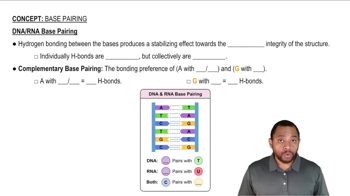
Base pairing refers to the specific hydrogen bonding between purines and pyrimidines in nucleic acids, which is essential for the structure of DNA and RNA. In DNA, adenine pairs with thymine, and guanine pairs with cytosine, while in RNA, adenine pairs with uracil. This complementary pairing ensures accurate replication and transcription of genetic information.
Recommended video:
Guided course
2:56
Base Pairing Concept 1