Pearson+ LogoPearson+ Logo
Ch.3 Matter and Energy
Timberlake - Chemistry: An Introduction to General, Organic, and Biological Chemistry 13th Edition
Timberlake13th EditionChemistry: An Introduction to General, Organic, and Biological ChemistryISBN: 9780134421353Not the one you use?Change textbook
Chapter 3, Problem 67

Calculate the energy to heat two cubes (gold and aluminum) each with a volume of 10 cm3 from 15 °C to 25 °C. Refer to Tables 2.8 and 3.11.

Verified step by step guidance
1
Step 1: Identify the given data for each cube (gold and aluminum). From the problem, the volume of each cube is 10 cm³, the temperature change (ΔT) is 25 °C - 15 °C = 10 °C. Refer to Tables 2.8 and 3.11 for the specific heat and density values of gold and aluminum.
Step 2: Calculate the mass of each cube using the formula: mass = density × volume. Use the density values for gold and aluminum from the referenced tables.
Step 3: Use the formula for heat energy: Q = m × c × ΔT, where Q is the heat energy, m is the mass, c is the specific heat, and ΔT is the temperature change. Substitute the values for gold into the formula.
Step 4: Repeat the calculation for aluminum using the same formula (Q = m × c × ΔT) and substitute the values for aluminum.
Step 5: Compare the calculated heat energy values for gold and aluminum to understand the difference in energy required to heat each cube.

Verified video answer for a similar problem:

This video solution was recommended by our tutors as helpful for the problem above.
Video duration:
6m
Was this helpful?

Key Concepts

Here are the essential concepts you must grasp in order to answer the question correctly.

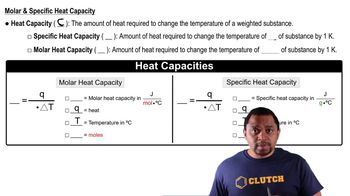
Specific Heat Capacity

Specific heat capacity is the amount of heat energy required to raise the temperature of one gram of a substance by one degree Celsius. It varies between materials, influencing how much energy is needed to heat or cool them. For example, gold and aluminum have different specific heat capacities, which will affect the calculations for heating them from 15 °C to 25 °C.
Recommended video:
Guided course
02:19
Heat Capacity

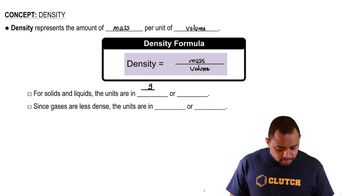
Density

Density is defined as mass per unit volume and is a critical property in determining how much a substance weighs for a given volume. In this problem, knowing the density of gold and aluminum allows us to calculate their masses based on the given volume of 10 cm³, which is essential for calculating the energy required to heat each material.
Recommended video:

Energy Calculation

The energy required to change the temperature of a substance can be calculated using the formula Q = mcΔT, where Q is the heat energy, m is the mass, c is the specific heat capacity, and ΔT is the change in temperature. This formula will be applied to both gold and aluminum to find the total energy needed to heat each cube from 15 °C to 25 °C.
Recommended video: