Pearson+ LogoPearson+ Logo
Ch.3 Matter and Energy
Timberlake - Chemistry: An Introduction to General, Organic, and Biological Chemistry 13th Edition
Timberlake13th EditionChemistry: An Introduction to General, Organic, and Biological ChemistryISBN: 9780134421353Not the one you use?Change textbook
Chapter 3, Problem 23b

Indicate whether each of the following statements describes potential or kinetic energy:
b. kicking a ball

Verified step by step guidance
1
Understand the difference between potential and kinetic energy: Potential energy is the energy stored in an object due to its position or state, while kinetic energy is the energy of motion.
Analyze the action described in the problem: Kicking a ball involves motion, as the ball moves after being kicked.
Determine the type of energy involved: Since the ball is in motion after being kicked, this is an example of kinetic energy.
Relate the concept to the situation: The act of kicking transfers energy to the ball, causing it to move, which is a characteristic of kinetic energy.
Conclude that the statement describes kinetic energy, as the energy is associated with the motion of the ball after being kicked.

Verified video answer for a similar problem:

This video solution was recommended by our tutors as helpful for the problem above.
Video duration:
1m
Was this helpful?

Key Concepts

Here are the essential concepts you must grasp in order to answer the question correctly.

Kinetic Energy

Kinetic energy is the energy possessed by an object due to its motion. It is calculated using the formula KE = 1/2 mv², where m is the mass of the object and v is its velocity. When a ball is kicked, it moves through the air, and this motion gives it kinetic energy, making it a clear example of kinetic energy in action.
Recommended video:
Guided course
01:19
Kinetic Molecular Theory Concept 1

Potential Energy

Potential energy is the stored energy in an object due to its position or state. For example, a ball held at a height has gravitational potential energy, which can be converted to kinetic energy when it is released. In the context of kicking a ball, potential energy is relevant only if the ball is stationary and elevated before being kicked.
Recommended video:
Guided course
01:26
Nature of Energy

Energy Transformation

Energy transformation refers to the process of changing energy from one form to another. In the case of kicking a ball, the energy stored in the leg muscles (chemical potential energy) is transformed into kinetic energy as the leg moves to kick the ball. Understanding this transformation is crucial for analyzing how energy is utilized in physical activities.
Recommended video:
Guided course
01:26
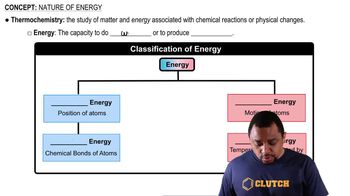
Nature of Energy