Pearson+ LogoPearson+ Logo
Ch.3 Matter and Energy
Timberlake - Chemistry: An Introduction to General, Organic, and Biological Chemistry 13th Edition
Timberlake13th EditionChemistry: An Introduction to General, Organic, and Biological ChemistryISBN: 9780134421353Not the one you use?Change textbook
Chapter 3, Problem 12c

What type of change, physical or chemical, takes place in each of the following?
c. A tree is cut into boards at a saw mill.

Verified step by step guidance
1
Identify the key characteristics of physical and chemical changes. A physical change involves a change in the state, shape, or size of a substance without altering its chemical composition. A chemical change results in the formation of new substances with different chemical properties.
Analyze the process described in the problem. Cutting a tree into boards involves changing the shape and size of the material, but the chemical composition of the wood remains the same.
Determine whether any new substances are formed during the process. Since no new substances are created and the wood remains chemically identical, this indicates a physical change.
Consider examples of similar processes, such as breaking a piece of glass or shredding paper, which are also physical changes because the material's chemical structure is unchanged.
Conclude that cutting a tree into boards at a sawmill is a physical change because it only alters the physical form of the wood without changing its chemical composition.

Verified video answer for a similar problem:

This video solution was recommended by our tutors as helpful for the problem above.
Video duration:
2m
Was this helpful?

Key Concepts

Here are the essential concepts you must grasp in order to answer the question correctly.

Physical Change

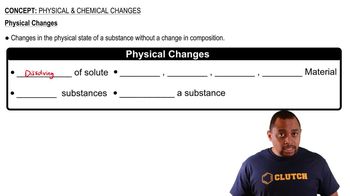
A physical change involves a transformation that does not alter the chemical composition of a substance. In this type of change, the material may change its form, size, or state, but its molecular structure remains intact. For example, cutting a tree into boards alters its shape and size but does not change the wood's chemical properties.
Recommended video:
Guided course
01:41
Physical and Chemical Changes

Chemical Change

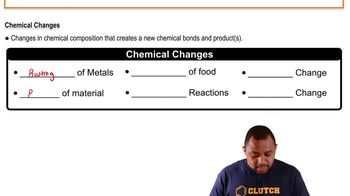
A chemical change results in the formation of one or more new substances with different chemical properties. This type of change involves breaking and forming chemical bonds, leading to a change in the molecular structure. Examples include combustion or rusting, where the original substances are transformed into entirely new materials.
Recommended video:
Guided course
01:53
Physical & Chemical Changes

Wood as a Material

Wood is an organic material derived from trees, primarily composed of cellulose, hemicellulose, and lignin. Understanding wood's properties is essential when discussing changes it undergoes. When a tree is cut into boards, it retains its chemical structure, indicating a physical change, while any subsequent processes like drying or treating the wood may involve chemical changes.
Recommended video:
Guided course
07:46
Laboratory Materials 2