Pearson+ LogoPearson+ Logo
Ch.3 Matter and Energy
Timberlake - Chemistry: An Introduction to General, Organic, and Biological Chemistry 13th Edition
Timberlake13th EditionChemistry: An Introduction to General, Organic, and Biological ChemistryISBN: 9780134421353Not the one you use?Change textbook
Chapter 3, Problem 11d

What type of change, physical or chemical, takes place in each of the following?
d. A puzzle is cut into 1000 pieces.

Verified step by step guidance
1
Identify the key difference between physical and chemical changes. A physical change alters the form or appearance of a substance without changing its chemical composition, while a chemical change results in the formation of new substances with different chemical properties.
Analyze the scenario: A puzzle is cut into 1000 pieces. Cutting the puzzle does not alter the material or composition of the puzzle; it only changes its shape and size.
Determine whether the change involves a transformation in the chemical structure of the material. In this case, the puzzle remains made of the same material, so no chemical bonds are broken or formed.
Conclude that the change is a physical change because the process only affects the physical appearance (size and shape) of the puzzle without altering its chemical composition.
Remember that physical changes are typically reversible (e.g., the puzzle pieces can be reassembled), whereas chemical changes are often irreversible or require a chemical reaction to reverse.

Verified video answer for a similar problem:

This video solution was recommended by our tutors as helpful for the problem above.
Video duration:
1m
Was this helpful?

Key Concepts

Here are the essential concepts you must grasp in order to answer the question correctly.

Physical Change

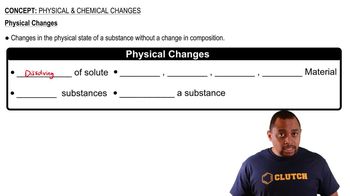
A physical change involves a transformation that does not alter the chemical composition of a substance. In this type of change, the material may change its form, size, or state, but its molecular structure remains intact. For example, cutting a puzzle into pieces changes its shape but does not affect the individual pieces' material properties.
Recommended video:
Guided course
01:41
Physical and Chemical Changes

Chemical Change

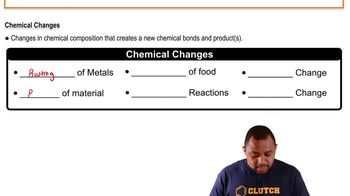
A chemical change results in the formation of one or more new substances with different chemical properties. This type of change involves a rearrangement of atoms and bonds, leading to a transformation that cannot be easily reversed. Examples include rusting iron or burning wood, where the original substances are fundamentally altered.
Recommended video:
Guided course
01:53
Physical & Chemical Changes

Distinguishing Between Changes

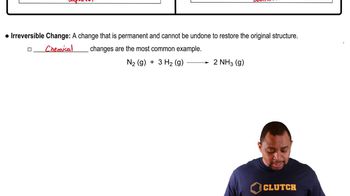
Understanding the difference between physical and chemical changes is crucial for analyzing various processes. Physical changes are typically reversible and do not involve changes at the molecular level, while chemical changes are often irreversible and involve new substances being formed. This distinction helps in categorizing reactions and understanding material properties.
Recommended video:
Guided course
01:17
Physical & Chemical Changes