Pearson+ LogoPearson+ Logo
Ch.3 Matter and Energy
Timberlake - Chemistry: An Introduction to General, Organic, and Biological Chemistry 13th Edition
Timberlake13th EditionChemistry: An Introduction to General, Organic, and Biological ChemistryISBN: 9780134421353Not the one you use?Change textbook
Chapter 3, Problem 10a

Describe each of the following as a physical or chemical property:
a. Neon is a colorless gas at room temperature.

Verified step by step guidance
1
Step 1: Understand the difference between physical and chemical properties. A physical property is a characteristic of a substance that can be observed or measured without changing its chemical identity, such as color, state of matter, or boiling point. A chemical property, on the other hand, describes a substance's ability to undergo a chemical change or reaction, such as flammability or reactivity.
Step 2: Analyze the given statement: 'Neon is a colorless gas at room temperature.' This describes the appearance (colorless) and state of matter (gas) of neon under standard conditions.
Step 3: Determine whether the property involves a change in the chemical identity of neon. Since the statement only describes observable characteristics (color and state) without any mention of a chemical reaction or change, it does not involve a chemical transformation.
Step 4: Conclude that the property described is a physical property because it pertains to the observable characteristics of neon without altering its chemical composition.
Step 5: Summarize the reasoning: The fact that neon is a colorless gas at room temperature is a physical property because it describes its physical state and appearance without involving a chemical change.

Verified video answer for a similar problem:

This video solution was recommended by our tutors as helpful for the problem above.
Video duration:
58s
Was this helpful?

Key Concepts

Here are the essential concepts you must grasp in order to answer the question correctly.

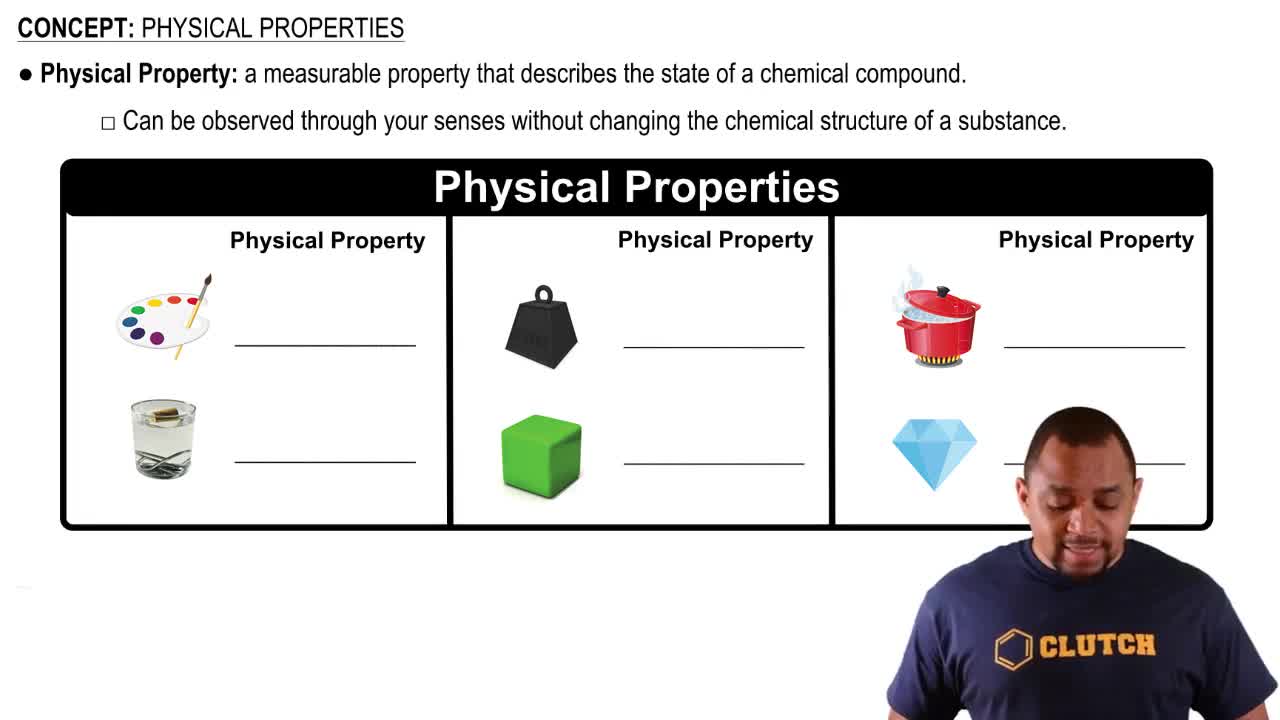
Physical Property

A physical property is a characteristic of a substance that can be observed or measured without changing its chemical identity. Examples include color, odor, boiling point, and state of matter. In the case of neon being a colorless gas at room temperature, this observation does not alter the chemical structure of neon itself.
Recommended video:
Guided course
02:54
Physical Properties Concept

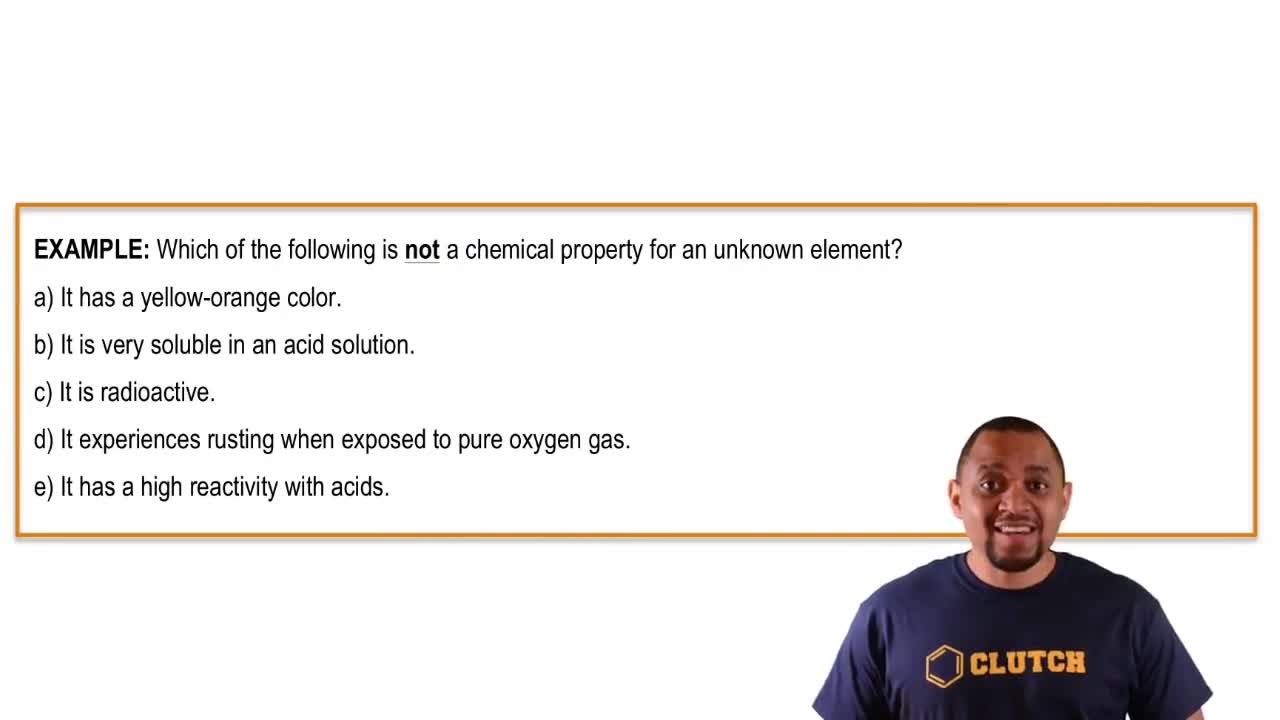
Chemical Property

A chemical property describes a substance's ability to undergo a specific chemical change or reaction. This includes reactivity with other substances, flammability, and acidity. Unlike physical properties, chemical properties can only be observed during a chemical reaction, which is not applicable to the description of neon as a gas.
Recommended video:
Guided course
02:11
Chemical Properties Example 1

State of Matter

The state of matter refers to the distinct forms that different phases of matter take on, primarily solid, liquid, gas, and plasma. Neon, being a gas at room temperature, indicates its state of matter, which is determined by temperature and pressure conditions. This property is crucial for understanding the behavior of gases in various environments.
Recommended video:
Guided course
01:35
States of Matter Concept 1