Pearson+ LogoPearson+ Logo
Ch.4 Atoms and Elements
Timberlake - Chemistry: An Introduction to General, Organic, and Biological Chemistry 13th Edition
Timberlake13th EditionChemistry: An Introduction to General, Organic, and Biological ChemistryISBN: 9780134421353Not the one you use?Change textbook
Chapter 4, Problem 11e

Identify each of the following elements as a metal, a nonmetal, or a metalloid:
e. located in Group 8A (18)

Verified step by step guidance
1
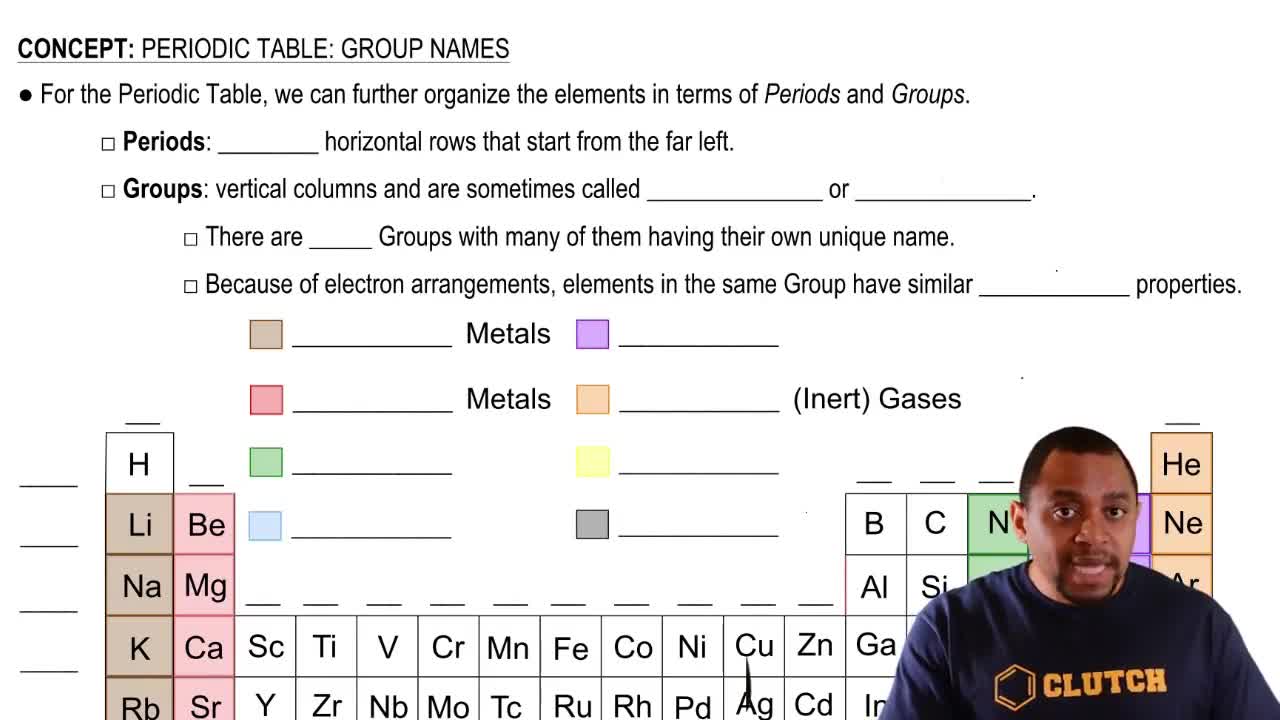
Step 1: Understand the periodic table grouping. Group 8A (or Group 18) is also known as the noble gases. These elements are located in the far-right column of the periodic table.
Step 2: Recall the properties of noble gases. Noble gases are characterized by their lack of reactivity due to having a full valence electron shell. They are nonmetals.
Step 3: Identify the elements in Group 8A. The elements in this group include helium (He), neon (Ne), argon (Ar), krypton (Kr), xenon (Xe), and radon (Rn).
Step 4: Classify the elements. Since all noble gases share similar chemical properties and are nonmetals, each element in Group 8A is classified as a nonmetal.
Step 5: Conclude that any element located in Group 8A (18) is a nonmetal based on its position in the periodic table and its chemical properties.

Verified video answer for a similar problem:

This video solution was recommended by our tutors as helpful for the problem above.
Video duration:
5m
Was this helpful?

Key Concepts

Here are the essential concepts you must grasp in order to answer the question correctly.

Periodic Table Groups

The periodic table is organized into columns called groups, which categorize elements based on similar chemical properties. Group 8A, also known as Group 18, contains the noble gases, which are characterized by their full valence electron shells, making them largely inert and nonreactive.
Recommended video:
Guided course
05:33
Periodic Table: Group Names

Noble Gases

Noble gases are a group of nonmetals found in Group 8A of the periodic table, including helium, neon, argon, krypton, xenon, and radon. They are known for their lack of reactivity due to having a complete outer electron shell, which makes them stable and unlikely to form chemical bonds.
Recommended video:
Guided course
14:42
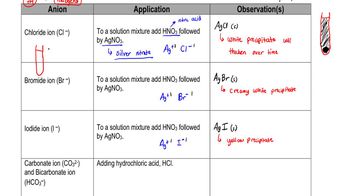
Test for Anions

Classification of Elements

Elements are classified into three main categories: metals, nonmetals, and metalloids. Metals are typically conductive and malleable, nonmetals are generally poor conductors and more brittle, while metalloids exhibit properties of both. Understanding these classifications helps in identifying the nature of elements in the periodic table.
Recommended video:
Guided course
04:19
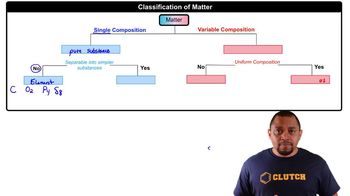
Classification of Matter