Pearson+ LogoPearson+ Logo
Ch.4 Atoms and Elements
Timberlake - Chemistry: An Introduction to General, Organic, and Biological Chemistry 13th Edition
Timberlake13th EditionChemistry: An Introduction to General, Organic, and Biological ChemistryISBN: 9780134421353Not the one you use?Change textbook
Chapter 4, Problem 14b

Using TABLE 4.4, identify the function of each of the following in the body and classify each as an alkali metal, an alkaline earth metal, a transition element, or a halogen:
b. Cu

Verified step by step guidance
1
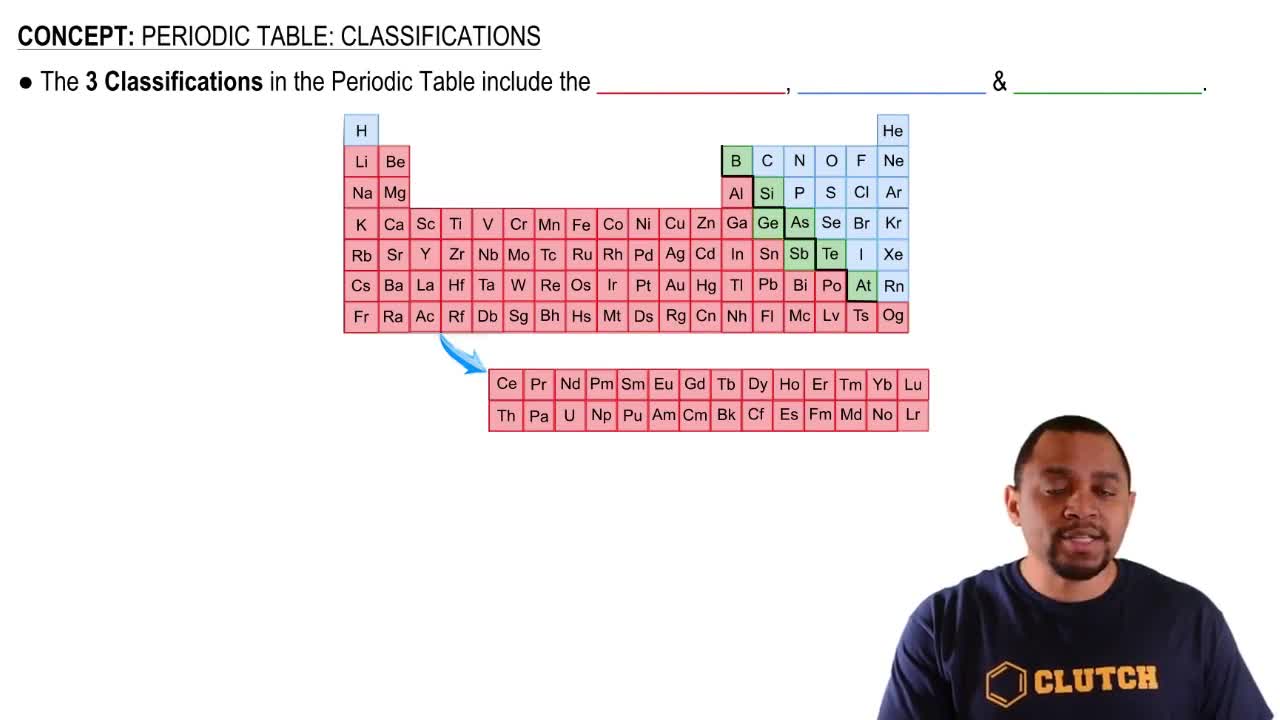
Step 1: Identify the element Cu (Copper) on the periodic table. Copper is located in Group 11 and Period 4.
Step 2: Determine the classification of Cu. Since it is in the d-block of the periodic table, it is classified as a transition element.
Step 3: Understand the role of Cu in the body. Copper is an essential trace element that plays a role in various enzymatic reactions, including those involved in energy production, iron metabolism, and the formation of connective tissue.
Step 4: Note that Cu is not an alkali metal (Group 1), alkaline earth metal (Group 2), or halogen (Group 17). It is specifically a transition element due to its position in the periodic table.
Step 5: Conclude that Cu is a transition element and has a biological function as a cofactor in enzymes critical for physiological processes.

Verified video answer for a similar problem:

This video solution was recommended by our tutors as helpful for the problem above.
Video duration:
1m
Was this helpful?

Key Concepts

Here are the essential concepts you must grasp in order to answer the question correctly.

Periodic Table Classification

The periodic table classifies elements into groups based on their properties and electron configurations. Elements are categorized into metals, nonmetals, and metalloids, with further subdivisions such as alkali metals, alkaline earth metals, transition metals, and halogens. Understanding this classification is essential for identifying the properties and functions of elements like copper (Cu).
Recommended video:
Guided course
02:40
Periodic Table: Classifications

Copper (Cu) Properties

Copper is a transition metal known for its excellent electrical and thermal conductivity, malleability, and ductility. It plays a crucial role in various biological and industrial processes, including electrical wiring and the formation of alloys. Recognizing its properties helps in understanding its function in the body and its classification within the periodic table.
Recommended video:
Guided course
02:11
Chemical Properties Example 1

Element Function in the Body

Elements in the body serve various functions, such as structural roles, enzyme cofactors, and components of biological molecules. Copper, for instance, is vital for iron metabolism, the formation of connective tissue, and the functioning of the nervous system. Identifying these functions is key to understanding the significance of elements like Cu in biological systems.
Recommended video:
Guided course
1:41
Ketone Bodies Example 1